Friday, May 28, 2010

Native Plant Landscaping talk wrap-up

Thanks to Liz Lodman and Barb Furlong of Montana Fish, Wildlife and Parks' Becoming an Outdoor Woman (BOW) program for hosting last week's native plant gardening workshop. BOW is a wonderful program, and if you haven't taken a class you should. And if you have, let FWP know how much you liked it. Anyway, thanks to both for organizing such a wonderful Native Plant Gardening Workshop. It was a fantastic turnout.

Many of you had garden design questions and specific plant questions. I did not mention it at the talk, but my wife and I have a garden coaching and consultation business, Butterfly Properties, LLC, specializing in sustainable garden design- native plant landscapes and gardens for wildlife,
Click here to download the list of easy to grow versatile and diverse native plants.
And here is a link to download my list of deer resistant native plants.

Here are some past blog posts that might be helpful:

Below are some of the books and references I talked about in the class:
  • The Magic of Montana Native Plants: A Gardeners Guide to Growing over 150 Species from Seed- Sheila Morrison
  • Bringing Nature Home- Douglas Tallamy
  • Shrink Your Lawn- Evelyn Hadden
  • Noah's Garden: Restoring the Ecology of Our Own Backyards- Sara Stein
  • Paradise by Design, Native Plants and the New American Landscape- Kathryn Phillips
  • The Forgotten Pollinators- Buchmann, Nabhan, and Mirocha
  • Landscaping Ideas of Jays- Judith Larner Lowry
  • Gardening with a Wild Heart -Judith Larner Lowry
Thanks again, and I hope you all enjoyed the workshop.

Sunday, May 9, 2010

The flickers are not nesting in the garden...

The flickers are not nesting in the garden...and I couldn't be happier. A puzzling statement to be sure, so let me explain...

We began about 10 years ago with nest box for northern flickers. These common, primary cavity nesters are facing many problems from loss of nesting habitat to pressures from invasive species (see here). In order to address the first issue we set up a nest box. This was very successful and effective, and based on how quickly they found the box and occupied it, it is obvious they are looking for, and are limited by, places to nest.

In front of my neighbor's house are decadent silver maples (see above), that you'd think would offer great nesting habitat for flickers, and they do, but unfortunately the cavities get occupied by squirrels instead, and have been for the 10 years we've lived beside them.

But it appears that this year the flickers will finally be nesting in one of these decadent trees and I couldn't be happier.
They did excavate our nest box (see photo at the top of the post), and I thought they were going to nest in it. But at the same time, they also excavated a cavity about 30' up one of the silver maples (photo above, arrow acknowledgement: Bike Garden), perhaps our nest box was a back-up for what inevitably happened when flickers tried to nest in the maples- squirrels would occupy the cavity. But maybe not this year.

Unfortunately wildlife gardening in an urban- or sub-urban setting is not just about planting the right plants and putting up nest boxes, unfortunately it is really about introduced pest management. The primary exotic pests here are starlings, house sparrow and squirrels. Controlling pests is not the most glamorous part of having a wildlife garden, but it is perhaps the most important.

In order to combat these invasive species, we have done several things- making the garden less hospitable for them is the first step , but then there is also control, or killing (click here for more information). As far as making the garden less hospitable, that starts with feeders and nest boxes (click here for information about lessening bird feeders), and native plant landscaping (see virtually any post on my blog for this thought!). Both feeders and nest boxes need to be designed for native birds, so no perches, only food they eat, and really very few feeders, and only seasonal ones (click here and here for more information).

Since we stopped feeding with sunflower seeds, we have seen the number of pests decline dramatically in the garden - including US native, but not Montana native, house finches, which essentially disappeared from the yard. In the summer, spring and fall, there is so much natural food, much of which we have planted, feeding is not important and mainly attracts unwanted, or invasive birds and animals, and it also causes unnatural high congregations of birds, that make them susceptible to other pests, like cats (click here for my thoughts on this).

Secondly we only use nest boxes that are appropriate for native species that we are likely to attract, not bluebird boxes for example (read more here).

Third there is control or killing squirrels. In our garden we have a trap set up, and any squirrel I trap, I kill. This started several years ago, and I went from over 200 squirrels/ year down to fewer than 20 last year and this year will be even fewer. As a result, we have seen birds use the garden much more often and differently than when squirrels patrolled the grounds. And most importantly, birds like northern flickers might just nest in natural places now. Like I said, this is the first year that I am thrilled the flickers will not nest in our garden- perhaps the greatest accomplishment in our wildlife garden so far.

Thursday, May 6, 2010

Native plant garden workshop wrap-up and plant sale announcement

Thanks to the Montana Natural History Center for hosting the native plant gardening workshop- I hope everyone was inspired to start gardening.
Here are links to blog posts of mine that we discussed:

You can search for any topic on the blog- make yourself at home on the blog and let me know if you have any questions.

Also, here is some exciting news: Native Plant Sale!

Fort Missoula Native Plant Garden's Annual Spring Spruce-up and Native Plant Sale!

Thursday May 13, 5:00-8:00 pm

  • Enjoy some refreshments and meet some good people
  • Learn about gardening for wildlife and sustainability while helping get the Teaching Gardens ready for summer programs
  • Bargain-priced native wildflowers, grasses and shrubs for sale; all proceeds directly benefit local restoration and education programs.
  • If you feel like volunteering we’ll be pulling some weeds and spreading mulch. Guided and self tours of the garden available.

Directions: Enter Fort Missoula via Old Fort Road and drive past Community Hospital.At the stop sign, go STRAIGHT.The road will make a T on Officer’s Row. Turn LEFT.Continue till the pavement ends. The garden is in front and to the left on the gravel drive-you'll see our white classroom.

RSVP to Leah Grunzke if you plan on attending or need more info. Hope to see you there!

Sunday, May 2, 2010

Nesting and Nest Box Camera Update

This was an exciting weekend for the nest box cameras. All three of our nest boxes have birds- northern flickers, black-capped chickadees, and red-breasted nuthatches. New this year, the flicker and chickadee boxes have nest cameras, including streaming the chickadee nest cam! The flicker cam will be streaming next. Here is the link to the streaming video of the chickadee box, though not much is going on during the day, but in the evenings and mornings a lot happens.

I installed the cameras and then packed the boxes with sawdust (click here for a description). This weekend, now that the boxes had been excavated, my wife and I focused the lenses and adjusted the camera angles, though based on the quality of the chickadee camera's video, we might need to do some more lens adjustments.

The photo above shows the chickadee nest box, camera, and the freshly excavated cavity filled with moss and squirrel fur. Based on the female's nest construction (see the video below), it looks like she will be laying eggs soon, then the real excitement begins.

Here is link a short video taken this evening of the female burrowing in to the nesting material to carefully create a pocket for the eggs.

Thursday, April 29, 2010

Nesting and bloom update

Wow. Things have changed in the garden. I was out of town for week and when I got back I was amazed how quickly things change this time of the year. Suddenly I feel like there is so much to do in the garden, and suddenly I am so far behind. Here is a brief update of the goings on...

It appears that everything has leaves, buds or flowers on it now; below I list what is in bloom.
Nesting Update
  • the chickadees are bringing nesting material into their box (click here for my favorite nesting material combo- squirrel and moss).
  • The flickers evidently completed the excavation of their box all while we were gone.
  • The mystery this year was what was happening in the nuthatch box? The nuthatches "claimed" this box early on, but then some chickadees began excavating it, and pretty regularly. And there was no sign of the pair of nuthatches. Were these the same chickadees that were also going to nest in the normal chickadee box? And who's ever heard of 2 pairs of chickadees nesting the same yard? Craziness- they need a couple of acres because of competition for food. But now, all has been revealed- the nuthatches have returned and they are now nearly completely done excavating their box.

Once they finish excavating they will probably continue their tiny onslaught of my bent willow furniture- shredding off the bark into fine nesting material for their little, freshly excavated cavity. Then they will carefully line to opening of the box with sap- lest I try to get back said components of my bent willow furniture. Order has been restored.
Bloom Update:

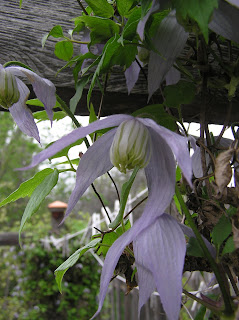
Flowering now- arrowleaf balsamroot (Balsamorhiza sagittata ), golden current (Ribes aureum), blue bells (Mertensia oblongifolia ), larkspur (Delphinium bicolor ), Jacobs ladder (Polemonium pulcherrimum), biscuitroot (Lomatium triternatum and L. dissectum), violets (Viola canadensis ) pasque flower (Pulsatilla patens), cutleaf daisy (Erigeron compositus, pictured above), blue virginsbower (Clematis occidentalis, see photo at beginning of the post of the virginsbower on my clothesline), prairie smoke (Geum triflorum), blue eyed mary (Collinsia parviflora, see below- this is one of my favorites, and it makes a nice groundcover), sivery lupine (Lupinus argenteus ), kittentails (Synthyris missurica ), Oregon grape (Mahonia repens ), and many more species flowering every day that it is hard to keep up.

So much to do. Last weekend I removed a little remnant lawn patch that I have had my eye on to turn from lawn to what I call a mowable prairie. In the lawn's place I planted natives that can be mown and maintained- like a lawn was originally intended- a meadow that could be mown to a height that would allow for paths and play areas. Instead of a lawn or a water hungry meadow, I planted this with drought tolerant, trample resistant natives like yarrow (Achillea millefolium ), hairy golden aster (Heterotheca villosa), mixed aster and erigeron species. After planting starts and transplants in the mowable prairie area, I covered the whole thing with mulch, but not just any mulch, gentle reader, a special mulch... this mulch is made from seed heads and flower parts I cut off last fall and kept in a bag out side all winter (cold stratification). Then I carefully (read: not at all) applied it to the surface of the fresh bed. I've found that with hairy golden aster, and my bag of assorted asters (by assorted I mean I can't really tell the difference between most asters and erigerons in my garden), they do great germinating when laid down in a mulch. I have been waiting for rain to do this, and by golly the rain has finally come (hopefully it will continue for a little while).

I did have a chance to also plant my potatoes, beets, peas, and other things I am probably forgetting and I finally built a new raised bed- for onions (see below, with cat guard installed), I moved the hill that was in its place and potted up all the asters and such that were on the hill. Maybe this weekend, I'll plant those potted up plants into the front yard or fill in other places in the yard.
Now I am well on my way to completing my 2010 garden project list (click here for this list). According to the list, the only thing left is making a new composter, but in reality, the list has really grown...

Lots going on suddenly, more updates with pictures to follow, oh and, a new arrival to the garden yesterday, a golden crowned kinglet.

Wednesday, April 14, 2010

Hummingbirds are coming

The 15th of April does not just mean the open date of spring black bear season in Montana, nor is it just the income tax filing date- to me the 15th of April is a reminder that the hummingbirds will be back soon. Hummingbirds are one of the few birds we set out feeders for. So its time to get them get them ready.
But nearly as important as providing feeders is planting native plants that flower coincidental with their arrival. Here wax currants (Ribes cereum) and golden currants (R. aureum) are the first to bloom, and golden currants (like the one above) are just about to flower in our yard and in Missoula. As a result, these are the most visited by the travel-weary humming birds (click here to read about other non-traditional humming bird plants).
This year, I am excited to have wax currants in our garden; while attending the Calypso Chapter of the Montana Native Plant Society's meeting, I bought three from Catherine Cain of Southwest Montana Native Landscapes and I found out that Kathy Settevendemie of Blackfoot Native Plant Nursery , who was also at the meeting, sells them as well.

The exact date of hummingbird arrival depends on native plants. Hummingbirds follow the blooms of many plant species on their way north to their nesting sites. It is these plants that provide them with the sustenance for their travels and will ensure plenty of food when they court, nest and raise their nestlings. So, hummingbirds are intimately tied to native plants. Just like butterflies, hummingbirds will feed on any flower at certain times, but the timing of the flowering of native plants is critical for them.

Planting firecracker penstemon (Penstemon eatonii), or other commonly described "hummingbird" plants may have little benefit to them (click here for more information and plant selections).
So its time to get those feeders ready, but, more importantly, get those native plants ready!

Oh, since my last post, I noticed that one of my favorites, the blue eyed Mary (Collinsia parviflora)is in full bloom, and so are kittentails (Synthyris missurica).

Monday, April 12, 2010

Early spring wildflowers in our yard

Here's a brief post- a look at what is flowering this week in our garden. Above are shooting stars (Dodecatheon conjugens), dramatic, if not tiny.

Below the prairie smoke (Geum triflorum) is pinking up.One thing I am really happy about is that we have incorporated a lot of diversity in our garden, and by diversity, I don't mean rare plants. Most plants in our garden are locally common and easy to grow. The reason I like this, is that what is flowering in our garden is also in bloom on the hills, forests and remnant short grass prairies around Missoula.
Below the prairie crocus or pasque flower (Pulsatilla patens) is starting to bloom in the shadier areas of our yard.


But in the front prairie, the is a lot more happening. The sagebrush buttercups (Ranunculus glaberrimus), the first to flower are still hanging on...

and so are the aptly named yellowbells (Frittellaria pudica).

I suspect if I looked hard enough, I'd find some lomatium in flower, but why spoil all the surprises in one day.
Soon, however, lots more species will join in the bloom, like bluebells (Mertensia oblongifloia),

larkspur (Delphinium bicolor),


and even arrowleaf balsamroot (Balsamorhiza sagittata), which had a good year last year. Let's hope the seedlings that showed their first leaves last year will be back for another. Then in a mere 5 or 6 six short years, our little prairie will be awash in balsamroot!


Saturday, April 3, 2010

Native Plant Society/ Native Plant Gardening Workshop Presentation

Thanks to Catherine Cain, the Calypso Chapter of the Montana Native Plant Society and the Big Hole Watershed Weed Committee for organizing such a wonderful Native Plant Gardening Workshop. It was a fantastic turnout, and I am already looking forward to attending next year's event.

As promised, click here to download a .pdf of the presentation I gave this morning.

Also, in talking to some of you this morning, here are some past blog posts that might be helpful:
How to remove your lawn
Important plants for hummingbirds
Time series and change in our garden
Growing a bird garden- a link to download the Montana Outdoors article
How to build a brush pile

Thanks again, and I hope you all enjoyed the workshop.

Friday, March 26, 2010

Upcoming Native Plant Gardening Workshops

Planning a garden?
This is my favorite time of the year- a time to plan and make some changes in your garden. If you are thinking about adding more native plants or attracting wildlife, here are two workshops I'll be teaching in the next month or so.

The first workshop, co-hosted by the Calypso Chapter of the Montana Native Plant Society and the Big Hole Watershed Weed Committee, focuses on native plants for creating a wildlife friendly garden, and it will be similar to the talk I gave the the Montana Nursery and Landscape Association annual meeting (Click here for more information or to download my presentation). This should be a wonderful event, and it is located in beautiful Divide, Montana on April 3.Click here to download the flyer


The second workshop will be held on May 1 in Missoula at the The Montana Natural History Center and covers using native plants in a sustainable landscape and deals more with plant selection and garden design. The workshop will feature classroom time and a visit to a local native plant garden (probably my home). Click here for a link to the Montana Natural History Center and information about registering for the class.
Space in both classes is limited, so register now! I hope to see you there.

Friday, March 19, 2010

Buttercups: someone's got to be first

Although they are not my favorite flower, per se, I do find myself photographing them the most and even writing about them as much as any other flower (click here for example). I'd be remiss if I didn't point them out the moment they start flowering. You don't hear me chronicling the side flowered mitreworts (Mitella breweri) first bloom, though.Sagebrush buttercups (Ranunculus glaberrimus) are, if nothing else, the first flowers to bloom in the spring, and these little flowers start the annual progression of flowers until October or November in our garden.
Don't get me wrong, they are beautiful flowers, and a fine plant in your garden, but they are not as my wife would say, "all that and a bag of chips". So what is "all that and a bag of chips?" June's new sweater. Our cat, June, has a new haircut (the lion cut) and a new spring wardrobe.