Showing posts with label bird feeder. Show all posts

Friday, March 3, 2017

A new use for this old blog; a reference


So I haven’t really been keeping up with this blog and frankly I am not sure of its fate. Since I haven’t been updating it regularly like I once did, this blog has turned into more of a static website, and I think that is fine. I think the value of this blog lies in is utility as reference and as a resource to cover topics in depth, but after eight (!) or so years, I find many of the issues with native plants and wildlife gardening keep coming up, so rather than reposting an old article or updating a subject I have written before,  I am thinking about turning these posts into a book (though I have been threatening that for a while). 


When I started this blog in 2009, social media was really (at least to me) in its infancy.  Now, platforms like Facebook, Twitter and Instagram are a more useful tool for updates and news.  As a result, I post garden news and pictures on these platforms, ignoring this blog.  But I do think the in depth articles I have posted are a compliment to a nice Instagram photo.  Having said that, some of the most commonly requested topics are the following:
In general, "why native plants are important" is always a common topic, and the subject of the whole blog!

I still post unique or timely things, like our Cat of the Year or SponCon projects, but day to day social media seems to suit the general needs of this one time blogger!

So, please follow me on Instagram or Facebook!

Sunday, January 19, 2014

The garden as a bird feeder

In general, our garden is our bird feeder- we planted native plants and created habitat to suit birds' primary food- insects.  And it has worked well, though it is not your traditional "birder's garden".  I feel like I have written this post before (and probably better), but it is a good reminder this time of the year.  For several years I have had mixed feelings for bird feeders, and I have stopped using bird feeders through summer, spring and fall.  I have stopped using seed feeders altogether, and occasionally and seasonally use different forms of suet feeders (see below), including native plant suet we prepare ourselves (click here).

Our goal is to make our garden our feeder by planting native plants and providing habitat and this sustains a variety of birds, insects and other wildlife. This has been our goal, and even in a small, city lot, you can have success.

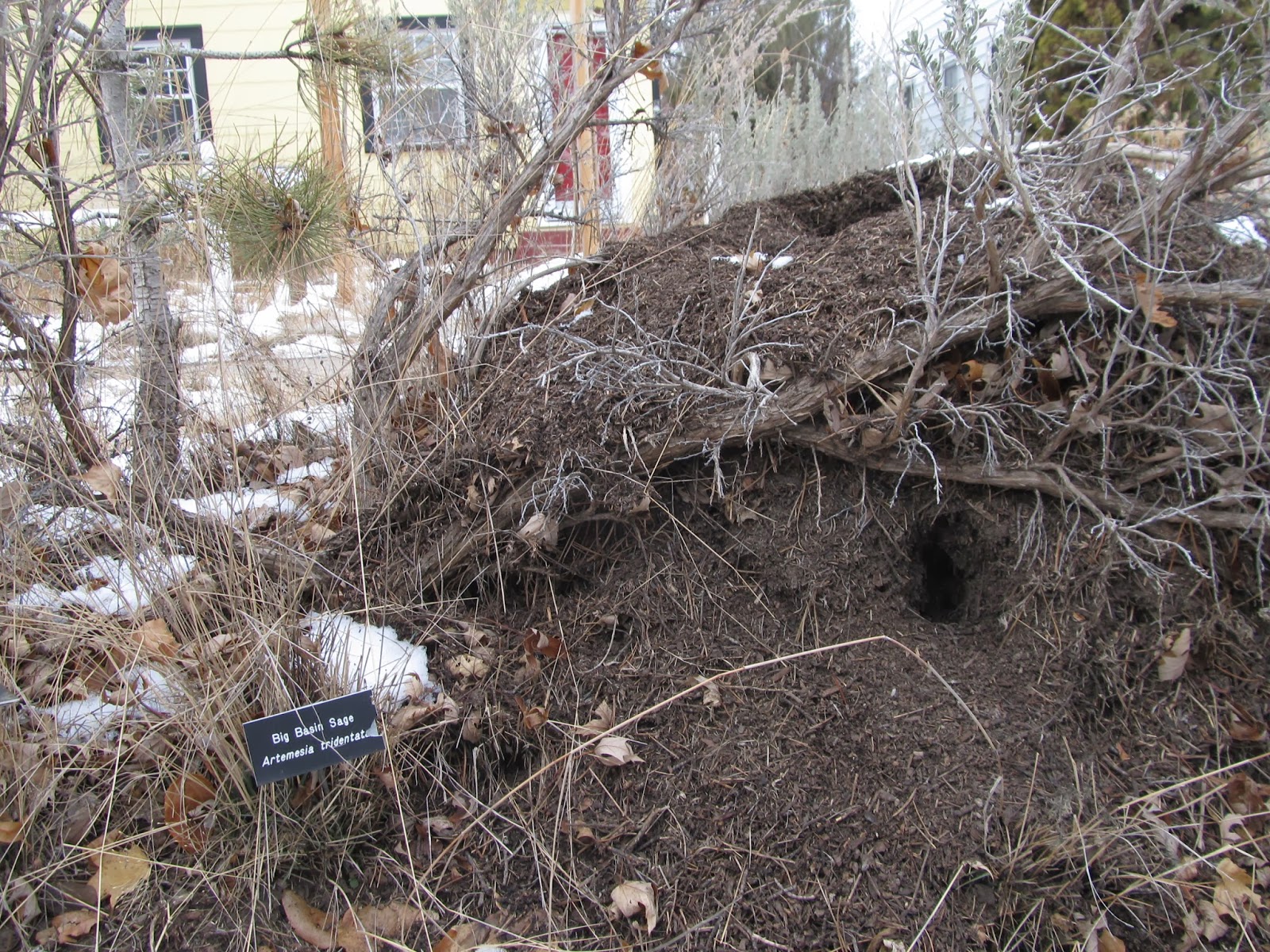
Our giant ant hill in our front yard is a Northern flicker's favorite.   Through the winter, flickers dig this up for tasty grubs (and defenseless slow moving adults in the cold).

In winter, we add some feeders for birds, but not the typical ones people are used to seeing, though non-traditional feeders, yet they are more natural. for example, my favorite, carcasses.
These parts and pieces are left overs from butchering our game meat during hunting season.

Although the aesthetic might not be for everyone, carcasses (from winterkill, and predator kills) are the original suet feeder (click here for more information). 

Even a little scapula can be an enticing feeder for chickadees, nuthatches, flickers, and downy woodpeckers.

In addition to providing housing for native solitary nesting bees, mason bee boxes, aka "larvae feeders" provide food for nuthatches, downy woodpeckers and chickadees that pick the overwintering larvae out. Here a chickadee uses its wings for improved leverage to get one out
But perhaps more important in our garden are the natural and original nest boxes- snags.
Birds are a source of food too. With a lot of birds around, come things that eat them.
Here a sharp-shinned hawk eats a cedar waxwing in our garden.
All that it left was the beak
So this winter, consider your feeders, and perhaps shift to some natural or unconventional feeders.  Feeding birds is a lot more than seed feeders, and it is a lot more effective with non-traditional means.

Saturday, November 19, 2011

Make your own native plant suet for the birds in your garden


Making your own suet for a backyard suet feeder is a fun project for the fall.  Suet, by the way, is animal fat, and it is a popular winter bird food. You can buy suet for bird feeders in the store, and often they have berries or insects or nuts mixed in.  "Suet" technically refers to the animal product (fat) but in the context of bird feeding, it refers to the fat plus whatever else is in there. More on fat later.

With the holiday season coming, homemade suet combined with an easy to make suet feeder is a great holioday gift for your bird-loving friends, or a holiday gift to the birds in your garden.  Plus, it is great way to use an otherwise unused product (tallow aka fat).

I am not a huge fan of bird feeders (click here for some thoughts on why), but I do set out a few suet feeders in the winter.  The main reason I don't like bird feeders is that they are not really effective if your goal is to get a lot of diversity.  Of the 60 species of birds that use our garden, less than 20% use the feeders.  Birds come to the garden for the structure, for the native plants and for insects, seeds, and berries, not the bird feeders.  However in the winter, the birds we are likely to encounter in the garden eat suet and need the high calories and fat it provides, and winter is an important time to consider your wildlife garden.  Suet is a natural food that in the wild (before backyard feeders were invented) comes from animal carcasses- either as a result of natural death (old age),winter kill or predators.  This is a seasonally importatnt source of food for a variety of birds ranging from little nuthatches and chickadees to ravens and magpies (and bald eagles, though we don't get them in our garden).

My favorite suet feeder is a rib cage.  It might look odd, but the birds recognize it!  Click here for more information)

Making your own suet is easy, and free, especially if your hunt or have access to suet.  A word about suet- there are many kinds of animal fat, and here I use the term "suet" to describe tallow, or the thick, chalky, white fat found just below the hide on an animal that provides them with insulation.  This is the least palatable of the fats and is discarded when butchering game.  Tallow covers the back and hind quarters and the rump of animals.  This is different from other types of fat, and is not "trim" which contains meat that you might get from a butcher to mix in with ground meat for burger.

If you butcher your own animals, you know what this is and you have a source for it, but even if you don't, or don't have a friend that hunts, you can still get this from the butcher (it is really cheap).  Just make sure to explain what you are looking for and what you are using it for.  You don't want to get anything that has meat on it.

Anyway, back to the bird food.  Below are all the ingredients we used today, and I got these from a quick lap around our garden- blue elderberries (Sambucus cerulea), rose hips from Wood's rose (Rosa woodsii), and mountain ash berries (Sorbus scoulina).  All native plants.

This brings up another reason I don't like conventional bird foods and mixes you get in the store: they contain plants that are either not suited to the native birds you might be trying to attract or there are weed seeds in the mix.  By using native plants you are guaranteed weeds won't be spread around.  Rose hips and elderberries are some of ther last berries to get eaten- birds seem to rely on freezing to make them more palatable.

If you don't have any berries or seeds in your garden, this is a great opportunity to get outside and look for what is available in your area.  And while to are out there, see if you can find a log for a suet feeder (see below).

This is what the tallow looks like.
The next step is optional.  I like to run the tallow through a grinder through a coarse grinding plate.  This breaks it down to uniform pieces and makes the rendering go quicker and smoother.
Here is the coarsely ground tallow.
The key to rendering the tallow is to melt it over a low heat.  You just want to melt the fat, do not boil it or cook it.  Stir it frequently, and, as is liquefies, and add more.  Once it is all rendered you could skim the top to get out any dirt, meat or cartilage, or if you really want, you could run it through a sieve, strainer or cheese cloth.  I don't think it is really necessary, though.

Add the nuts or berries to the rendered tallow and mix it thoroughly.  Again, you don't need to cook it, just make sure it is mixed and smooth.  There are many suet recipes that suggest adding flour or corn starch, but I don't think it is really necessary.

Once it is all mixed, ladle into a form that best fits you suet feeder.  My favorite suet feeder (apart from a rib cage) is really simple to make and is really enjoyed by the birds.  Click here for more information on how to build it, but all it is is a log with some 1-2" deep holes drilled into it.
Because of these cavities I like to put the suet into ice cube trays.  Each hole in the suet feeder is about the size of an ice cube, so it makes the kind of messy job of filling the feeder, easy.
Set the suet outside to cool , and then fill up and install your suet feeder.

Wednesday, June 15, 2011

2011 will be remembered as the year of the aphid

WARNING!  This blog post contains explicit images of mucivory.


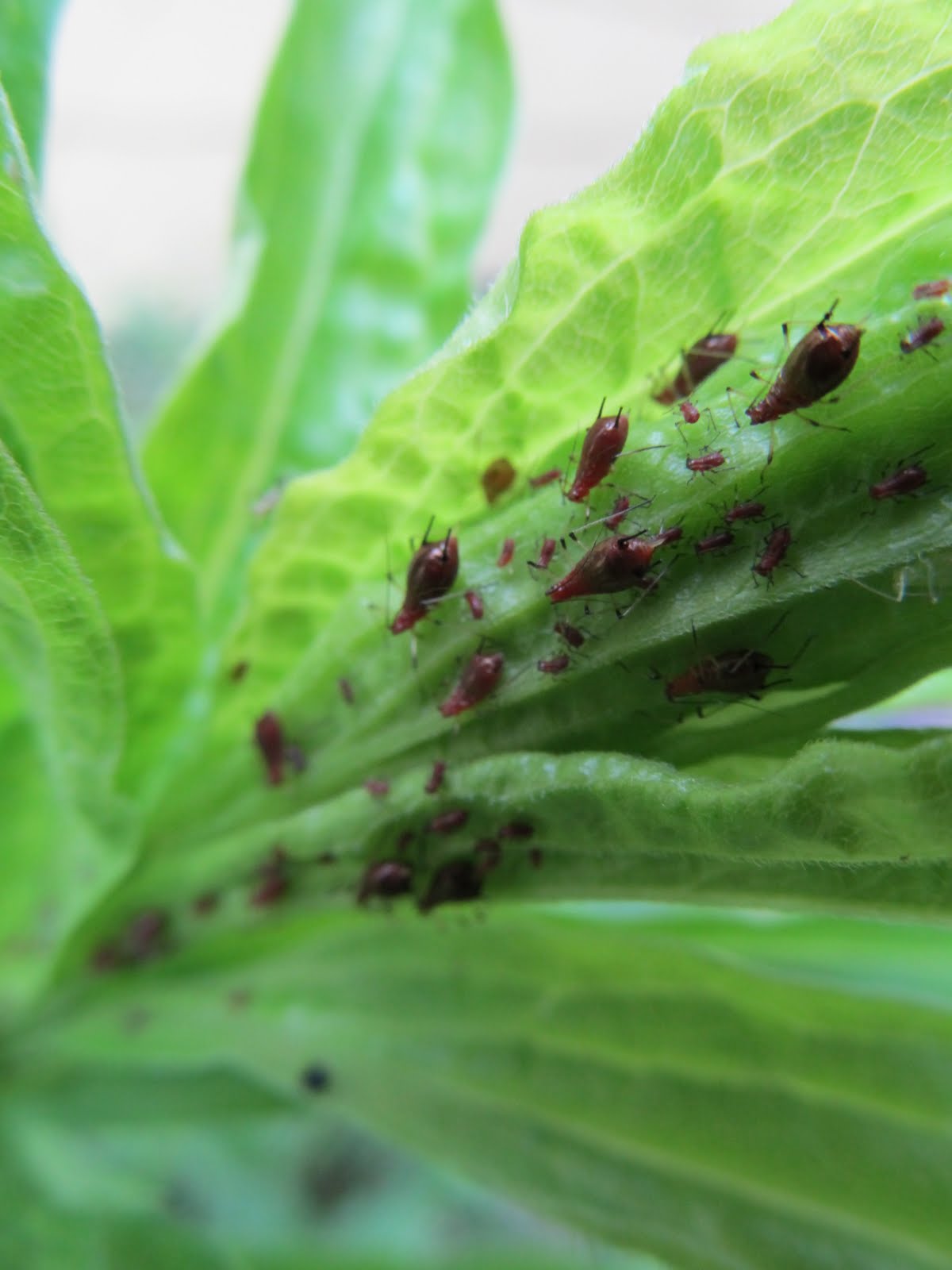
Every year, and every season, is different in the garden.  This year has been cool and wet, and some plants have really benefited like the arrow leaf balsamroot (Balsamorhiza sagittata), and some are having a tougher time like bitterroot (Lewisia rediviva).  That is why diversity in the garden is so important; and interesting.  The biggest benefactor, this year seems to be the aphids, though I am not sure why.  The abundance and diversity of aphids this year is incredible (on our native plants that is, not on our eggplants and peppers). 

A few years ago I was excited to find the red goldenrod aphids had finally colonized a little patch of goldenrod (Solidago missouriensis).  Last year though, none were in sight. 

This year it seems there are aphids on many species, different aphids on each of our goldenrod species (S. missouriensis, S. canadensis, and S. ridgida). 

Not just goldenrods, though.  There are aphids on our big basin sage (Artemisia tridentata - though they are there every year), red osier dogwood (Cornus sericea), 
chokecherry (Prunus virginiana), and 
Wilcox’s penstemon (Penstomon wilcoxii). 
This is even the first year I’ve seen aphids on our Ponderosa pines (Pinus ponderosa).  There are over 350 species of aphids, and most are host-plant specific.  That is, they only feed on a species of plant or plants that share a common genus. 
Compared to when our eggplants or peppers get aphids, when our native plants get colonized by a lot of aphids, it rarely results in damage to the plant.  Actually, our big basin sage seems to thrive in the presence of aphids. 

On our Ponderosa pines we have the giant conifer aphids (Cinara spp.).  These feed on the branches and stems, not on the leaves, and few arborists even consider these a threat.

All these aphids, though are really providing a lot of food for all the birds in the garden that glean insects from the leaves.  Also a benefactor is all the insects that feed on their soft bodies, which I am learning about thanks to my latest project- my insect collection. 

So far that has been a wonderful experience, and I am learning so much, even more than I expected (thanks again to Jen Marangelo from the Missoula Butterfly House and Insectarium ).  I am simply amazed by the diversity of bees, and flies that are wasp- and bee-mimics.  I am even really impressed by all the species of ladybird beetles in the garden- the sworn, mortal enemy of the aphid.

Sunday, December 27, 2009

Backyard birding: a year in review

Having wildlife in my backyard is one the greatest rewards from native plant gardening. One easily quantifiable indicator, of the "success" of our garden is the number and diversity of species of birds that use our yard and variety of uses they have for our garden.

Although it is obviously difficult to ascribe the abundance and diversity of birds using our yard to native plant landscaping (their are no controls or replicates in this study), I look back to our previous home just five blocks away- a house we rented, and did not landscape. There we were only able to attract a few species; house sparrows, pigeons, house finches and European starlings. Our current home is in the same neighborhood, same ecotype, same proximity to natural areas, etc...but we have landscaped our yard with wildlife in mind.

Compared to the past few years, we changed little in our garden in 2009, the exception from a backyard birding standpoint is that we have been feeding less and less (click here for my feelings on this). We have cut back and stopped feeding black sunflower seeds- they tended to draw in undesirable species like house finches and squirrels (read more about squirrels here), and instead the only feed we provide is suet (click here for our conventional and unconventional feeders) and hummingbird feeders seasonally.
Here are a few highlights from 2009:
  • 40 species of birds used our yard this year. In total we have had about 60 species use the yard over the last 10 years (here is the list). Some exceptions this year were red polls (haven’t seen them in a while, and not since a "cold" (read: normal) winter, blue jays (don’t know why), and many species of warblers (though I might have missed them between building our greenhouse and training for a couple of marathons).
  • American robins were the first to return (Feb. 16) and the mountain chickadee (Dec. 14) was the most recent arrival.
  • One new species to our backyard bird list- the Brown creeper. Though not an uncommon bird, we had never had one in our yard before.
  • Black capped chickadees had two clutches. Though this happens every year, I still love it.
  • Northern flickers had a clutch. The noteworthy thing about that this year was the the male was a hybrid of two morphs and the female disappeared early on, leaving him to raise the nestlings.

Here is the list of birds in 2009:

Year-round or resident bird species
American Crow
Black-billed Magpie
Black-capped Chickadee
Cedar Waxwing
Dark-eyed Junco* (*fall-spring resident)
Downy Woodpecker
House Finch
Northern Flicker
Red-breasted Nuthatch
Sharp-shinned Hawk
2009 bird arrivals to our garden
Mountain chickadee December 12
Pine siskin October 4
White crowned sparrow October 3
Yellow rumped warbler October 3
Dark eyed junco October 3
House wren August 22
Olive-sided Flycatcher August 16
Hairy Woodpecker August 1
Northern Oriole May 28
Warbling Vireo May 27
Western Wood Pewee May 24
Yellow Warbler May 24
Wilson's Warbler May 23
Western Tanager May 21
American Goldfinch May 20
Gray Catbird May 20
Chipping sparrow May 18
Lincoln's sparrow May 16
Dusky flycatcher May 14
Black-chinned hummingbird May 12
Rufous hummingbird May 10
Ruby crowned kinglet May 2
Calliope hummingbird May 2
Golden crowned kinglet April 29
Bohemian Waxwing March 27
Varied Thrush March 26
Song Sparrow March 22
Brown Creeper March 16
Mourning Dove Feb. 21
American Robin Feb. 16

Monday, December 7, 2009

winter in the wildlife garden


It is cold and getting colder. Temps are predicted to be around -20 degrees F (not including wind) and highs are forecasted to be in the low single digits for the next few days. And, on top of that, there is the wind. It is below zero now, and it is only getting colder. This is an important time to think about wildlife in the garden.

While working in my woodworking shop yesterday (where it was very warm, by the way), I spent a lot of time watching birds and what they were up to in the garden. It was a lot of fun and gratifying to see the wildlife garden in action. I even braved the cold and -20 degree wind-chill to take some pictures (maybe “brave” is too strong of a word).

Winter roosts
The northern flicker in the photo above has been spending the night in the nest box to escape the cold. This is the same male that excavated the nest box this past spring and raised a clutch in our yard (he has a distinguishable nape crest). Although it is important to clean and fill nest boxes annually, especially ones that you fill with nesting material (see here for information), it is important to leave these boxes empty for the winter and not refill them until February.

Brush piles, bird nesting boxes, snags and rock piles are such important features for a variety of wildlife species in the garden. These elements allow birds and other animals to escape conditions that would otherwise be inhospitable and unavailable in a "clean" yard- that is a yard with only a manicured lawn and some nicely pruned specimen trees.

Feeding
We don't feed very much, even in the winter by most standards (click here for more information). Our primary feeder is our garden- the seeds, berries, insects and others results of our garden design. For example, downy woodpeckers are spending a lot of time drilling our aspens looking for borers (click here for the fascinating, never ending borer story), and flickers are emboldened by the cold to excavate our anthill in search of cold weary (and defenseless) ant. These are the most reliable and most diverse feeders we have.
Pictured above is a song sparrow sitting on one of our fallen snags eating seeds from an aster. We do feed suet in the winter (click here for directions to build an easy one), and black sunflower seeds though not the latter for some time. Just having suet available for winter birds, seems to attract the fewest pest species.
Knowing what species are likely to visit your feeders is important in determining what to set out as food. Generic “bird food” usually end s up unused or wasted, or attracted non-native or pest species (like eastern squirrel species, European starling, house sparrows or house finches). In our yard, the primary winter birds include black capped chickadees, red breasted nuthatches, northern flickers, dark eyed juncos, downy woodpeckers, and others.
One unconventional feeder that is really effective is a natural suet feeder. Though this might look a little odd to some, a deer, elk or antelope carcass is just what lots of birds love, including chickadees, nuthatches and magpies. This is what store-bought, conventional suet feeders try to imitate. After butchering game, I will usually hang a ribcage in the backyard for birds to peck at and feed on. Yesterday as I watched, the chickadees and nuthatches never went to a typical suet feeder, but rather spent all their time feeding on the deer ribcage. Consider hanging your ribcage for the birds, or if you don’t hunt, and you are interested in adding a conversation piece/ feeder to your yard, stop by a wild game butcher, I am sure they will give you a ribcage.

Thursday, September 10, 2009

Fall in the garden

While not technically fall yet, with nights getting in to the 30's and cottonwood leaves turning golden, fall will be here soon. For a lot of reasons, fall is my favorite time of the year, and it is one of my favorite times in the garden. This is the time of the year I really like our little prairie and the look of many of our plants.

It is easy to like flowers in the garden, everyone does, but this time of the year, the grasses are cured golden brown, and the textures of the different species dominate. It is this time of the year, a lawn-alternative garden is much more interesting to me. Some plants, whose flowers are delicate and beautiful, now looking sinister and uninviting like the wavy leaf thistle (Cirsium undulatum, in photos below). In the summer their flowers draw our attention and the attention of butterflies, and in the fall and winter other insects and birds delight in their seeds.
This is a fun time to celebrate the dormancy of plants. Although there my be the temptation to water some plants, try to avoid watering and make a make a native garden something it is not, embrace the changes. This is a fun time of the year to prune, dead head and do some garden maintenance. It is a time to build brush piles for wildlife, and to leave seeds for birds to eats in the winter.
Some recent rains have given new life to some plants. The elkhorn clarkias (Clarkia pulchella) and yellow evening primroses (Oenethera flava) have returned from dormancy and begun flowering (see photo below), some blue flax (Linum lewisii), blanket flowers (Gallarida aristata), and asters (Aster and Erigerion spp.) have also started flowering again.
These small bits of color are made more extreme in contrast to the shades of brown. The browns, though, look and feel more natural this time of year, and give the garden a proper sense of place and season. Bright green irrigated lawns look that much more out of place in the west in autumn.
It is another season to enjoy the garden.

Wednesday, August 12, 2009

Build a suet feeder in five minutes

If you have about five minutes to spare, here are instructions for building a suet feeder for birds this fall/winter. As part of the native plant and wildlife gardening workshop I taught at BOW a couple of weekends ago, I built these simple suet feeders with the class and people really liked them. It is a very simple feeder I have been using for 10 years or so, and it is the main feeder we use in the winter. Although I do have mixed feeling for bird feeders (click here for more information and more thoughts on bird feeders), I'm pretty comfortable using this one. The lack of perches and the placement of suet holes deter non-native birds like house sparrows, European starlings, and house finches. Those species like to perch on something while they eat, but native birds feed on suet and in the cavities and crevices of trees are "clingers" and are used to walking up and down trees.

These feeders are very easy to build (a great project for kids), and they are surprisingly effective for a variety of native birds including chickadees, nuthatches, brown creepers, many species of woodpeckers, and even juncos. I think the reason these feeders are so effective is that they mimic the trees (since they are, in fact, made of trees) that many native birds use for natural foods like insects and spider eggs. So, it is no surprise that birds have the search image of a log with treats inside.

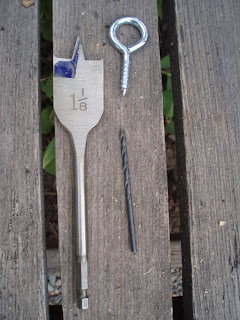
Pictured below is everything you need to make one of these suet feeders- a log , a screw eye (I use #6), a drill bit to pre-drill the hole for the screw eye, and spade bit to drill holes for suet (1"- 1 1/4" ), and a drill.

Start with selecting a log. Any size will work (at least 8" long), the taller the better and at least 4" in diameter. It is nice to have a variety of sizes in your garden, some small ones that will only accommodate little birds like nuthatches, and some larger that will satisfy big woodpeckers.

Drill a pilot hole in one end for the screw eye.

Install the screw eye. Now you are almost done!

Then, bore out holes for the suet. Place as many as you'd like, and drill them about 1" deep. Try to keep the upper holes at least 4" from the top, so non-native birds won't be able to perch on the top and reach down into the holes.


Load the cavities with suet- it is easiest, but messiest to do this when the suet is room temperature.

Install and watch for birds- let me know how they work.