Showing posts with label birds. Show all posts

Friday, June 2, 2017

Catio


If you like your cats and you like wildlife, do them both a favor and keep your cats inside.  Cats live longer, healthier lives as indoor cats, and wildlife and your neighbor’s vegetable beds benefit from not having your cats roaming the neighborhood.  Study after study demonstrates not only the adverse effect that house cats have on wildlife (from song birds to the endangered Florida panther), but how far your seemingly lazy, well-fed little friend actually travels.  Also, study after study finds how much shorter cats lives are when they are allowed to roam. 

Cats are curious and like to look outside, and watch birds, people, leaves, whatever, and we try to provide them with ways of doing just that.  One minor thing I did was add a window to one of our storm doors, so they can look out when the door is closed.  
Chester is dissatisfied with just a window.
They use the window a lot, but they also would like to spend more time enjoying the sights, sounds and smells of the garden.  
The window looks both ways and is effective for not just cats, but chickens and Chihuahuas.
Winston gets supervised time in the garden (the only one of our cats that does), but it is seldom and I know he likes to feel the wind in his hair, so that lead to my recent project- a Catio (“cat” + “patio” = awesome).  
From left to right, Winston, Chester and Gary investigating their new Catio.
I first learned about a Catio a few years ago from an announcement for a Catio Tour in Portland.  I was intrigued.  The fifth annual tour is scheduled for September 9.

This was a fun project and one that I could get all the materials from Home ReSource (using reused and repurposed materials is one of my passions).  This Catio is made from 3 wood frame window screens and these screens are common at Home ReSource.

These window screens sell for about $3 each and they are a common byproduct of people upgrading their windows in Missoula.  They were really common on the vast amount of homes built here between the 1910’s and the 50’s.  It is nice to find a use for a common thing like these (and hollow core doors, but that is another issue).  

The rest of the Catio is constructed from 2x stock reclaimed from homes), plywood from shipping crates, reused lag bolts, screws, and the brackets (above) are re-purposed fence posts.   

I also got laminate flooring, roofing felt, flashing, drip edge, roofing nails, wood screws, and carpet remnants for the Catio furniture (the scratching post), 

In all this project cost about $35.

It is not totally complete, I plan to add a shelf (a second floor) for the cats to lounge, but I wanted to see how that enjoy and use the current space. 

One of the nice things about this project is that it is portable.  Ultimately, we plan to install French doors in place of this window.  When we get around to that project (or “if”), we can move this to another window.  

the Catio installed from our bedroom window
This will allow our cats some time to spend outside but protects them, and protects our wildlife visitors from them. 

Wednesday, August 20, 2014

Bird list

Although I’ve been spending a lot of time posting on this blog about birds, and spending time in the garden watching birds, it has been our new chickens. 
However, after a social at our garden, I was reminded it was time to update my garden bird list. After some investigating, I realized the bird list on my blog had become woefully out dated (and I realized I was not the Montana "Chicken" Gardener, but the Montana "Wildlife" Gardener). I hadn’t formally updated the bird list on my blog since about 2009. 

Despite that I spend a lot of my time at work building, maintaining, accessing and editing databases, evidently my bird list is not in one! So, after some copy and pasting, and tediously searching my blog, I have revised my bird list. And here it is.

For those interested in exclusively the number, that number is 71.


Some details about my bird list, this list probably under-represents some species (like flycatchers- I don’t even really try with those!), and I only count birds that use the garden. That is, I don’t count fly-over’s, or even birds I can see from my yard- they have to be doing something like scratching on the ground, gleaning insects from leaves, bathing, nesting, eating one another, etc… To me flyovers are just happenstance- they do not reflect what I am trying to accomplish in the garden, that is, to create habitat for a variety of wildlife using plants native to the Missoula area.


I was struck by several things after reviewing the list.

  1. Apparently I need to spend some time reading my own blog. This year I remarked that the vesper sparrow as a new arrival in the garden- they same way I made that proclamation in 2010. 
  2. Birds that were once annual common like common redpoll and pine siskin in the winter, I haven’t seen in 10 years. 
  3. A lot of common, local birds aren’t in the garden, and some uncommon local birds are. 
  4. If I counted fly-over’s, I would have a lot more birds on my list (bald eagles, red tailed hawks, osprey, great blue heron, turkey vultures, red tailed hawks, Canada geese, canvasbacks, blue winged teal, mallards, California gulls, etc…) regularly fly overhead. Even rock doves. 
  5. I grudgingly acknowledged the trash birds- the one’s I try to keep out; house sparrows, Eurasian collard doves, and European starlings in this list
In all, it is pretty cool to see this list. I can remember almost every one of these species, and I am really excited about attracting them to our little garden on 8th Street. And it all comes down to the fact that birds eat insects, and insects need our native plants.

Sunday, January 19, 2014

The garden as a bird feeder

In general, our garden is our bird feeder- we planted native plants and created habitat to suit birds' primary food- insects.  And it has worked well, though it is not your traditional "birder's garden".  I feel like I have written this post before (and probably better), but it is a good reminder this time of the year.  For several years I have had mixed feelings for bird feeders, and I have stopped using bird feeders through summer, spring and fall.  I have stopped using seed feeders altogether, and occasionally and seasonally use different forms of suet feeders (see below), including native plant suet we prepare ourselves (click here).

Our goal is to make our garden our feeder by planting native plants and providing habitat and this sustains a variety of birds, insects and other wildlife. This has been our goal, and even in a small, city lot, you can have success.

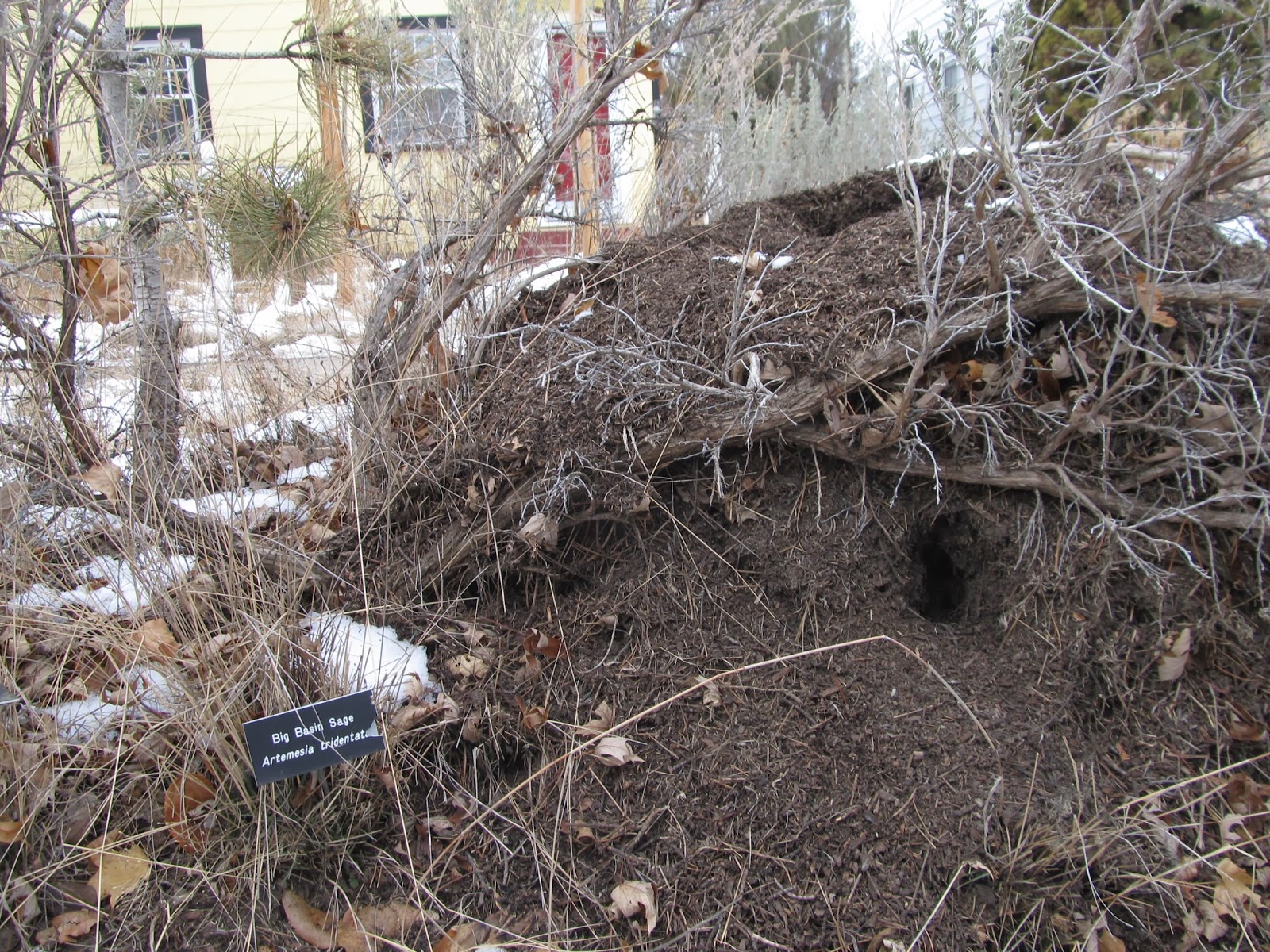
Our giant ant hill in our front yard is a Northern flicker's favorite.   Through the winter, flickers dig this up for tasty grubs (and defenseless slow moving adults in the cold).

In winter, we add some feeders for birds, but not the typical ones people are used to seeing, though non-traditional feeders, yet they are more natural. for example, my favorite, carcasses.
These parts and pieces are left overs from butchering our game meat during hunting season.

Although the aesthetic might not be for everyone, carcasses (from winterkill, and predator kills) are the original suet feeder (click here for more information). 

Even a little scapula can be an enticing feeder for chickadees, nuthatches, flickers, and downy woodpeckers.

In addition to providing housing for native solitary nesting bees, mason bee boxes, aka "larvae feeders" provide food for nuthatches, downy woodpeckers and chickadees that pick the overwintering larvae out. Here a chickadee uses its wings for improved leverage to get one out
But perhaps more important in our garden are the natural and original nest boxes- snags.
Birds are a source of food too. With a lot of birds around, come things that eat them.
Here a sharp-shinned hawk eats a cedar waxwing in our garden.
All that it left was the beak
So this winter, consider your feeders, and perhaps shift to some natural or unconventional feeders.  Feeding birds is a lot more than seed feeders, and it is a lot more effective with non-traditional means.

Wednesday, February 27, 2013

Upcoming Speaking Engagements

Spring is nearly here and people are thinking about their gardens.  This spring and summer I have a few speaking engagements across the state.

The first one (pictured above), is sponsored by the Calypso Chapter of the Montana Native Plant Society and University of Montana Western's School of Outreach.  I have had the pleasure of speaking to this group in past years and I had a wonderful time with the very interested and engaged crowd.  RSVP soon- space is limited and it typically fills up.  Contact outreach@umwestern.edu to register or for more information.

Date:  April 6
Location: Beautiful Divide, MT at the Grange Hall
Topic:  Insects in the Native Garden


Next on the list is a little more vague- I'll be doing a presentation with the Montana BOW (Becoming and Outdoor Woman) program (a program I am a huge fan of), and we are thinking of central or north-central Montana- tentatively in Lewistown or Malta, sometime between May 1 and May 15.  As you can see, there are still some details to work out.  Contact Liz Lodman for more information (or to lobby for a location!).

The next presentation is a combination presentation and field trip to our garden.  This one is also part of the BOW program, and is part of summer BOW.  Summer BOW is a wonderful experience, if you have ever thought about learning to fish, shoot, hunt, identify birds, navigate in the woods, or learn about native plan gardening (!), and you are a woman, consider taking this workshop.  Montana BOW is such a fantastic program and I really enjoy participating any time I an invited.
Sign up soon- summer BOW fills up quickly!  Contact Liz Lodman for more information.
Date:  Aug 2-4 (my presentation and field trip is Aug 3)
Location:  Lubrecht Forest, Greenough, MT

Hope to see you at one of these presentations!
Think gardening.

Sunday, June 3, 2012

Chickadee update: they fledged


The black-capped chickadees that had been nesting in our garden fledged this morning, and fortunately I was able to watch it all.  I took this lousy video of the last two leaving the box.  Even though the video quality is not too good, it is still adorable to watch them fly out of the box for the first time.

It is always amazing how quickly they grow- just a couple of weeks ago they were eggs.

Here is a video from inside the nest box on May 15 showing the first 4 hatchlings getting fed for the first time

There is a good chance they will have a second clutch, and if they do, you can watch all the action inside the nest box on our live streaming video.

Thursday, May 17, 2012

Birding Workshop, Becoming and Outdoors Woman- June 22-24


Here is a great opportunity for beginning birders “to learn to identify birds through field marks, sounds and habitat,” said Liz Lodman, Montana Fish, Wildlife and Parks coordinator of the Becoming an Outdoors-Woman workshops.
I am pleased to be teaching a session on backyard birding, where I will cover creating habitat for birds in your yard, a discussion of appropriate feeders and ways to provide housing.


The Becoming an Outdoors Woman program is a fantastic program run by Montana Fish, Wildlife and Parks. I’ve had to opportunity to teach classes to this group in the past and it has always been a wonderful experience.

The birding workshop begins Friday evening, June 22, at the Ninepipes Lodge near Charlo, and runs through noon on Sunday. Experienced bird watchers from across the state will share their knowledge of Montana’s birds and will lead morning and evening bird walks. The workshop also includes a bird and wildlife watching tour of the National Bison Range.

“Wildlife viewing is one of the fastest growing outdoor activities,” Lodman said. “This workshop will be a great opportunity to learn the basics you need to actively enjoy bird watching.”

Register ASAP, these courses always fill up fast!

The workshop fee is $98, and includes all meals during the workshop. Participants are responsible for their own lodging. To register, visit http://fwp.mt.gov/education/bow/workshops.html. Or contact Liz Lodman by phone 406-444-9940, email: llodman@mt.gov;

Saturday, November 19, 2011

Make your own native plant suet for the birds in your garden


Making your own suet for a backyard suet feeder is a fun project for the fall.  Suet, by the way, is animal fat, and it is a popular winter bird food. You can buy suet for bird feeders in the store, and often they have berries or insects or nuts mixed in.  "Suet" technically refers to the animal product (fat) but in the context of bird feeding, it refers to the fat plus whatever else is in there. More on fat later.

With the holiday season coming, homemade suet combined with an easy to make suet feeder is a great holioday gift for your bird-loving friends, or a holiday gift to the birds in your garden.  Plus, it is great way to use an otherwise unused product (tallow aka fat).

I am not a huge fan of bird feeders (click here for some thoughts on why), but I do set out a few suet feeders in the winter.  The main reason I don't like bird feeders is that they are not really effective if your goal is to get a lot of diversity.  Of the 60 species of birds that use our garden, less than 20% use the feeders.  Birds come to the garden for the structure, for the native plants and for insects, seeds, and berries, not the bird feeders.  However in the winter, the birds we are likely to encounter in the garden eat suet and need the high calories and fat it provides, and winter is an important time to consider your wildlife garden.  Suet is a natural food that in the wild (before backyard feeders were invented) comes from animal carcasses- either as a result of natural death (old age),winter kill or predators.  This is a seasonally importatnt source of food for a variety of birds ranging from little nuthatches and chickadees to ravens and magpies (and bald eagles, though we don't get them in our garden).

My favorite suet feeder is a rib cage.  It might look odd, but the birds recognize it!  Click here for more information)

Making your own suet is easy, and free, especially if your hunt or have access to suet.  A word about suet- there are many kinds of animal fat, and here I use the term "suet" to describe tallow, or the thick, chalky, white fat found just below the hide on an animal that provides them with insulation.  This is the least palatable of the fats and is discarded when butchering game.  Tallow covers the back and hind quarters and the rump of animals.  This is different from other types of fat, and is not "trim" which contains meat that you might get from a butcher to mix in with ground meat for burger.

If you butcher your own animals, you know what this is and you have a source for it, but even if you don't, or don't have a friend that hunts, you can still get this from the butcher (it is really cheap).  Just make sure to explain what you are looking for and what you are using it for.  You don't want to get anything that has meat on it.

Anyway, back to the bird food.  Below are all the ingredients we used today, and I got these from a quick lap around our garden- blue elderberries (Sambucus cerulea), rose hips from Wood's rose (Rosa woodsii), and mountain ash berries (Sorbus scoulina).  All native plants.

This brings up another reason I don't like conventional bird foods and mixes you get in the store: they contain plants that are either not suited to the native birds you might be trying to attract or there are weed seeds in the mix.  By using native plants you are guaranteed weeds won't be spread around.  Rose hips and elderberries are some of ther last berries to get eaten- birds seem to rely on freezing to make them more palatable.

If you don't have any berries or seeds in your garden, this is a great opportunity to get outside and look for what is available in your area.  And while to are out there, see if you can find a log for a suet feeder (see below).

This is what the tallow looks like.
The next step is optional.  I like to run the tallow through a grinder through a coarse grinding plate.  This breaks it down to uniform pieces and makes the rendering go quicker and smoother.
Here is the coarsely ground tallow.
The key to rendering the tallow is to melt it over a low heat.  You just want to melt the fat, do not boil it or cook it.  Stir it frequently, and, as is liquefies, and add more.  Once it is all rendered you could skim the top to get out any dirt, meat or cartilage, or if you really want, you could run it through a sieve, strainer or cheese cloth.  I don't think it is really necessary, though.

Add the nuts or berries to the rendered tallow and mix it thoroughly.  Again, you don't need to cook it, just make sure it is mixed and smooth.  There are many suet recipes that suggest adding flour or corn starch, but I don't think it is really necessary.

Once it is all mixed, ladle into a form that best fits you suet feeder.  My favorite suet feeder (apart from a rib cage) is really simple to make and is really enjoyed by the birds.  Click here for more information on how to build it, but all it is is a log with some 1-2" deep holes drilled into it.
Because of these cavities I like to put the suet into ice cube trays.  Each hole in the suet feeder is about the size of an ice cube, so it makes the kind of messy job of filling the feeder, easy.
Set the suet outside to cool , and then fill up and install your suet feeder.