Showing posts with label squirrels. Show all posts
Showing posts with label squirrels. Show all posts
Tuesday, April 26, 2011
This is what happens at the nest box while I'm at work...
So, I've always wondered what goes on when I am not watching. That is one of the reasons we installed nest box cameras in the flicker and chickadee boxes. In order to see if anyone is checking out the boxes for nesting, I devised what I call a NIB (Nesting Indicator Bar), some might call it a twig. I install the NIB in the entry hole of the nest box, and if it gets removed, I know something has been exploring the nest box. So, when I leave for work, the NIB is in place, and when I get home, it is gone. Sure, I know something has been in there, but what happened? To figure this out, I recently installed a motion activated camera in front of the nut hatch box. For eight years or so red breasted nuthatches have been nesting in this box, so I assumed that every time the NIB is gone, it is because a nuthatch took it out.
In the end I was right, but if you watch the slide show, you'll see a lot more happens. Watch closely and you'll see that it begins and ends with a nuthatch on the box and excavating, but in between it gets visited by a black capped chickadee, a northern flicker, a house sparrow, my neighbor's cat and a squirrel. Let's just say, that squirrel, isn't going to bother the nuthatches.
By the way, the nuthatches have excavated the box, and are just about done filling it with nesting materials.


Monday, June 14, 2010
A new visitor to the garden
 This morning I found a raccoon in the garden, and I'm not sure how I feel about it.
I consider raccoons a class 3 non-native species; this is according to my own little classification system (European starlings are a class 1, for example). Raccoons are not native to most of Montana, but are now widely spread across the state (this I have personally confirmed with roadkill observations). They are native to a small area in extreme eastern Montana, but they were never really common there. Their range has expanded throughout the state (and in the northern Rockies) in the last 50 years as a result of urban- and suburban-ization. Development, tree planting and food subsidies (garbage, pet food, and intentional feeding) has facilitated their range expansion. Raccoons are native to the US, and they have not been introduced by people (as far as I know), but since they are not native they have the ability to disrupt indigenous plant and animal communities and compete with other native animals.
They are similar in many ways to other non-natives we have in Montana, like Eastern and gray squirrels and house finches. All three of these are native to the US but not native to Montana, and all have been transported and introduced outside their native range by people. Squirrels have become a conservation issue and are really a problem (read more here , for example). On the other hand, house finches, which are native to the south western US but now occur all over the west, are merely a nuisance. I'm not aware of them being a conservation issue (as a little aside, since we stopped feeding sunflower seeds to birds, the house finches are uncommon in our yard).
So, I am not sure what to think of the new visitor. I will do some research and observation, and keep an eye the the little fellow for now.
Friday, June 4, 2010
Nesting, nestling and fledging update
There is a lot going on with nesting birds in our garden. We have northern flickers, black-capped chickadee, and red-breastered nuthatches in various stages of nesting and fledging in nest boxes in our small backyard. Here is a breif run down on the actvity....
Black- capped chickadees
The chickadees should fledge any time now- they are ready to go but have probably been delayed by this rain. By the way, thank goodness for the rain!
If you haven't done so already check out the inside of the nest box with our streaming nest camera. But you'd better hurry because they are about to fledge. Click here to go inside the nest box.
At the beginning of this posts is a short video my wife took of the outside of the box and one of the adults feeding the young. For those that only know the chickadees from the inside of the nest box, this view might be interesting.
One thing I am really excited about is that we will be able to capture the mysterious second clutch this year on camera. every year, the chickadees have a second clutch, even after a typically very fruitful first clutch. The second clutch is usually smaller, and takes less time to fledge. It has aways appeared that the young from the first clutch help in raising (or at least with the feeding), the second clutch. Hopefully, though we'll be able to learn a little more of what is going on. It is not really common that chickadees have two clutches, so I am excited to learn more.
Red-breasted nuthatches
These little fellas have been a bit overlooked this year, I am sad to say. Not that they care, but theirs is the only box in which we did not install a nest cam. As a result, we have been so focused on the chickadees and the flicker business, that these little guys have been almost ignored (not really, but relatively). Anyway, they should be fledging any day now, too, but without all the fanfare. One interesting thing to note with these nuthatches, is that there are nuthatches nesting in the nest box I installed at the 8th Street Pocket Park, which is just a block away. Every so often these two nuthatch factions defend their little territories, which is kind of neat.
Northern flickers
Wow, they have had an eventful spring. Here is a little story of their spring...
 I hope they can raise a clutch- it is getting late for them.
Once the chickadees fledge we will switch to the flickercam for nest box viewing. Exciting.
Black- capped chickadees
The chickadees should fledge any time now- they are ready to go but have probably been delayed by this rain. By the way, thank goodness for the rain!
If you haven't done so already check out the inside of the nest box with our streaming nest camera. But you'd better hurry because they are about to fledge. Click here to go inside the nest box.
At the beginning of this posts is a short video my wife took of the outside of the box and one of the adults feeding the young. For those that only know the chickadees from the inside of the nest box, this view might be interesting.
One thing I am really excited about is that we will be able to capture the mysterious second clutch this year on camera. every year, the chickadees have a second clutch, even after a typically very fruitful first clutch. The second clutch is usually smaller, and takes less time to fledge. It has aways appeared that the young from the first clutch help in raising (or at least with the feeding), the second clutch. Hopefully, though we'll be able to learn a little more of what is going on. It is not really common that chickadees have two clutches, so I am excited to learn more.
Red-breasted nuthatches
These little fellas have been a bit overlooked this year, I am sad to say. Not that they care, but theirs is the only box in which we did not install a nest cam. As a result, we have been so focused on the chickadees and the flicker business, that these little guys have been almost ignored (not really, but relatively). Anyway, they should be fledging any day now, too, but without all the fanfare. One interesting thing to note with these nuthatches, is that there are nuthatches nesting in the nest box I installed at the 8th Street Pocket Park, which is just a block away. Every so often these two nuthatch factions defend their little territories, which is kind of neat.
Northern flickers
Wow, they have had an eventful spring. Here is a little story of their spring...
- They excavated out nest box
- They also excavated a cavity in a silver maple in front of my neighbors house
- They laid eggs in the cavity in the maple
- European starlings evicted them from their nest
- The starlings are nesting in the tree
- The flickers left the area
- Last weekend the flickers returned to the nest box, and as of yesterday (June 3)have laid at least 2 eggs (in the photo below- kind of poor qualiy but it is a video capture).
I hope they can raise a clutch- it is getting late for them.Once the chickadees fledge we will switch to the flickercam for nest box viewing. Exciting.
Sunday, May 9, 2010
The flickers are not nesting in the garden...
 The flickers are not nesting in the garden...and I couldn't be happier. A puzzling statement to be sure, so let me explain...
We began about 10 years ago with nest box for northern flickers. These common, primary cavity nesters are facing many problems from loss of nesting habitat to pressures from invasive species (see here). In order to address the first issue we set up a nest box. This was very successful and effective, and based on how quickly they found the box and occupied it, it is obvious they are looking for, and are limited by, places to nest. 
In front of my neighbor's house are decadent silver maples (see above), that you'd think would offer great nesting habitat for flickers, and they do, but unfortunately the cavities get occupied by squirrels instead, and have been for the 10 years we've lived beside them.
But it appears that this year the flickers will finally be nesting in one of these decadent trees and I couldn't be happier.
 They did excavate our nest box (see photo at the top of the post), and I thought they were going to nest in it. But at the same time, they also excavated a cavity about 30' up one of the silver maples (photo above, arrow acknowledgement: Bike Garden), perhaps our nest box was a back-up for what inevitably happened when flickers tried to nest in the maples- squirrels would occupy the cavity. But maybe not this year.
Unfortunately wildlife gardening in an urban- or sub-urban setting is not just about planting the right plants and putting up nest boxes, unfortunately it is really about introduced pest management. The primary exotic pests here are starlings, house sparrow and squirrels. Controlling pests is not the most glamorous part of having a wildlife garden, but it is perhaps the most important.
In order to combat these invasive species, we have done several things- making the garden less hospitable for them is the first step , but then there is also control, or killing (click here for more information). As far as making the garden less hospitable, that starts with feeders and nest boxes (click here for information about lessening bird feeders), and native plant landscaping (see virtually any post on my blog for this thought!). Both feeders and nest boxes need to be designed for native birds, so no perches, only food they eat, and really very few feeders, and only seasonal ones (click here and here for more information).
Since we stopped feeding with sunflower seeds, we have seen the number of pests decline dramatically in the garden - including US native, but not Montana native, house finches, which essentially disappeared from the yard. In the summer, spring and fall, there is so much natural food, much of which we have planted, feeding is not important and mainly attracts unwanted, or invasive birds and animals, and it also causes unnatural high congregations of birds, that make them susceptible to other pests, like cats (click here for my thoughts on this).
Secondly we only use nest boxes that are appropriate for native species that we are likely to attract, not bluebird boxes for example (read more here).
Third there is control or killing squirrels. In our garden we have a trap set up, and any squirrel I trap, I kill. This started several years ago, and I went from over 200 squirrels/ year down to fewer than 20 last year and this year will be even fewer. As a result, we have seen birds use the garden much more often and differently than when squirrels patrolled the grounds. And most importantly, birds like northern flickers might just nest in natural places now. Like I said, this is the first year that I am thrilled the flickers will not nest in our garden- perhaps the greatest accomplishment in our wildlife garden so far.
Thursday, April 29, 2010
Nesting and bloom update
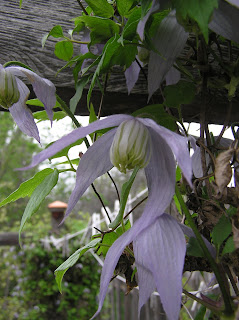 Wow. Things have changed in the garden. I was out of town for week and when I got back I was amazed how quickly things change this time of the year. Suddenly I feel like there is so much to do in the garden, and suddenly I am so far behind. Here is a brief update of the goings on...
It appears that everything has leaves, buds or flowers on it now; below I list what is in bloom.
Nesting Update
- the chickadees are bringing nesting material into their box (click here for my favorite nesting material combo- squirrel and moss).
- The flickers evidently completed the excavation of their box all while we were gone.
- The mystery this year was what was happening in the nuthatch box? The nuthatches "claimed" this box early on, but then some chickadees began excavating it, and pretty regularly. And there was no sign of the pair of nuthatches. Were these the same chickadees that were also going to nest in the normal chickadee box? And who's ever heard of 2 pairs of chickadees nesting the same yard? Craziness- they need a couple of acres because of competition for food. But now, all has been revealed- the nuthatches have returned and they are now nearly completely done excavating their box.
 Once they finish excavating they will probably continue their tiny onslaught of my bent willow furniture- shredding off the bark into fine nesting material for their little, freshly excavated cavity. Then they will carefully line to opening of the box with sap- lest I try to get back said components of my bent willow furniture. Order has been restored.
 Bloom Update:
Flowering now- arrowleaf balsamroot (Balsamorhiza sagittata ), golden current (Ribes aureum), blue bells (Mertensia oblongifolia ), larkspur (Delphinium bicolor ), Jacobs ladder (Polemonium pulcherrimum), biscuitroot (Lomatium triternatum and L. dissectum), violets (Viola canadensis ) pasque flower (Pulsatilla patens), cutleaf daisy (Erigeron compositus, pictured above), blue virginsbower (Clematis occidentalis, see photo at beginning of the post of the virginsbower on my clothesline), prairie smoke (Geum triflorum), blue eyed mary (Collinsia parviflora, see below- this is one of my favorites, and it makes a nice groundcover), sivery lupine (Lupinus argenteus ), kittentails (Synthyris missurica ), Oregon grape (Mahonia repens ), and many more species flowering every day that it is hard to keep up. 
So much to do. Last weekend I removed a little remnant lawn patch that I have had my eye on to turn from lawn to what I call a mowable prairie. In the lawn's place I planted natives that can be mown and maintained- like a lawn was originally intended- a meadow that could be mown to a height that would allow for paths and play areas. Instead of a lawn or a water hungry meadow, I planted this with drought tolerant, trample resistant natives like yarrow (Achillea millefolium ), hairy golden aster (Heterotheca villosa), mixed aster and erigeron species.  After planting starts and transplants in the mowable prairie area, I covered the whole thing with mulch, but not just any mulch, gentle reader, a special mulch... this mulch is made from seed heads and flower parts I cut off last fall and kept in a bag out side all winter (cold stratification). Then I carefully (read: not at all) applied it to the surface of the fresh bed. I've found that with hairy golden aster, and my bag of assorted asters (by assorted I mean I can't really tell the difference between most asters and erigerons in my garden), they do great germinating when laid down in a mulch. I have been waiting for rain to do this, and by golly the rain has finally come (hopefully it will continue for a little while).
I did have a chance to also plant my potatoes, beets, peas, and other things I am probably forgetting and I finally built a new raised bed- for onions (see below, with cat guard installed), I moved the hill that was in its place and potted up all the asters and such that were on the hill. Maybe this weekend, I'll plant those potted up plants into the front yard or fill in other places in the yard.
After planting starts and transplants in the mowable prairie area, I covered the whole thing with mulch, but not just any mulch, gentle reader, a special mulch... this mulch is made from seed heads and flower parts I cut off last fall and kept in a bag out side all winter (cold stratification). Then I carefully (read: not at all) applied it to the surface of the fresh bed. I've found that with hairy golden aster, and my bag of assorted asters (by assorted I mean I can't really tell the difference between most asters and erigerons in my garden), they do great germinating when laid down in a mulch. I have been waiting for rain to do this, and by golly the rain has finally come (hopefully it will continue for a little while).I did have a chance to also plant my potatoes, beets, peas, and other things I am probably forgetting and I finally built a new raised bed- for onions (see below, with cat guard installed), I moved the hill that was in its place and potted up all the asters and such that were on the hill. Maybe this weekend, I'll plant those potted up plants into the front yard or fill in other places in the yard.
 Now I am well on my way to completing my 2010 garden project list (click here for this list). According to the list, the only thing left is making a new composter, but in reality, the list has really grown...
Lots going on suddenly, more updates with pictures to follow, oh and, a new arrival to the garden yesterday, a golden crowned kinglet.
Monday, February 9, 2009
The inconvenient truth about wildlife gardening: squirrel control
 This post is intended for wildlife gardeners in the western U.S. or in other places where squirrels have been introduced and have displaced native squirrels and native birds. Eastern fox and gray squirrels are both native to the mid-Atlantic states and west to the eastern part of South Dakota. Both species eat a variety of foods ranging from seeds and grains, to buds and fruits, insects, birds' eggs, birds (both nestlings and adults) and even reptiles.
Both species have been introduced outside their native range over the last century. Populations continue to expand coinicidental with developemt along the urban interface and developemnt of wild areas. Changes in land use and cover, including fire suppression, planting trees, and alteration of flow regimes in rivers, have increased forests and woodland corridors, especially along riparian areas west of the Mississippi. In addition to range expansion following development, non-native squirrels have also been purposely introduced into cities and towns in the western U.S. and even into Europe. Both non-native species are tolerant of humans and developemnt and thrive in urban and suburban settings. In these new environments, there are no natural controls and squirrel populations quickly expand (especially thanks to bird feeders).
Although they thrive around human development, they don't just stay in town. Their populations expand from urban centers out to the urban fringe or interface zones, and utimately into natural areas. Introduced squirrles are more then a nusience, they are a real conservation problem. In their introduced ranges they threaten and displace native squirrels (the western gray in some western states and the red squirrel in western Montana) and non-native squirrels are a huge problem for cavity nesting birds.
There are many books and web sites that claim that if you simply feed squirrels they will leave you, your birds and your bird feeders alone. Do not believe it. This just creates more squirrels and just creates a larger problem, especially for birds. Squirrels do not just eat bird food set out at feeders by well-meaning gardeners, they take nesting cavities, nesting places (see picture above of squirrel in flicker nest box), displace birds, kill nestlings and monopolize ground foods for ground feeding birds.
Dealing with squirrels is not a part of wildlife gardening that most people look forward to. Nevertheless, it is necessary to control their numbers. Notice I say “control their numbers” not “eradicate.” It would be impossible to eradicate them, but with intensive management you can control their densities and limit their effect on other species. Controlling non-native squirrels will improve conditions for bids and other small wildlife in your yard, and in your neighborhood. Since reducing the number of squirrels in our yard, we have a lot more ground foraging birds, and they spend a lot longer in the yard.
How to control squirrels
The first step is to reduce or eliminate anything that is benefiting them. Make sure your feeders are squirrel-proof, and there are a variety of ways to do this. Also, look around your neighborhood and see if any of your neighbors are specifically feeding squirrels, or if they have feeders that might be feeding squirrels. Talk to neighbors and try to get a concerted approach to this- it will be more effective and a great opportunity for education and outreach. Removing a source of food and nesting areas may be enough to reduce the density of squirrels in your area. Unfortunately, it might not be, and you might have to take more drastic steps.
How to remove squirrels or reduce their density around your yard. The best thing to do is kill them. This is not fun, but it is necessary. If you live in a city or urban area, there is probably an ordinance that prohibits shooting, even with a pellet gun or BB gun. If you can shoot squirrels legally, use a .22 or a shotgun. A pellet gun is quiet, but a .22 is not much louder, and much more effective for a quick, humane kill.
 In any case, I think it is best to use a live trap (like this one). This is what I use. You can easily bait the trap with peanut butter on a small piece of cardboard. Place in an area where squirrels congregate like under a bird feeder. Once you set the trap, you will need to check it at least twice a day. It is imperative you do not leave the squirrel trapped for too long- the shorter it is trapped the less stressed it will be, and more humane. Occasionally, dark eyed juncos will get trapped in the cage, but they are easily released unharmed. This is another reason for checking the trap frequently.
Once you have caught a squirrel in the trap, the next step is to kill it. There are a few methods here all are quick, and humane. You can drown them- this sounds awful but it is remarkably quick. Another approach I have not tried is to use carbon monoxide. You can place the trap (with the squirrel still in it), in a bag and attached the bag to your tailpipe. This sounds like of strange and elaborate, but evidently the squirrel will fall asleep and die in minutes. Surprisingly, drowning takes much less than 1 minute. If it is legal to discharge a firearm in your area, the best thing might be to shoot the squirrel in the head with a pellet gun while it is in the trap.
Once you have a dead squirrel, what do you do with it?
You have a few options (I have tried a combination of most of these at some point):
- Eat them
- Allow birds and insects to eat them
- They make great nesting material for chickadee nests (see here)
- Compost them
- Donate to raptor rehabilitation (or similar) in your area
It is remarkable how the birds have responded to having fewer squirrels in the yard. Ground feeding birds are much more common and they spend more time foraging, like white-crowned sparrows, hermit thrushes, song sparrows, and northern flickers.
In closing, remember that while squirrel control is not the most fun aspect of wildlife gardening, but it is a part of making a wildlife haven in your yard. The non-native squirrels are yet another human impact to the world that decreases native species’ chances at survival.
Sunday, February 8, 2009
Birdhouse basics
 Spring is almost here and in this part of the world, February is an important time to think about birdhouses. February is when birds begin courting and looking for nesting places. Having a bird nest and raise its chicks in your yard is very gratifying for wildlife gardeners. Now is the time to install bird houses and to do seasonal maintenance on them (see below).
Although it is fun to see birds nest in your yard, there are many things to consider before hanging a birdhouse. Know what species of bird you want to attract and have reasonable expectations. Birdhouse need to be designed for a specific bird species to be successful and to not foster exotic, invasive species (like European starlings and house sparrows in much of North America, including Missoula). Generic bird houses that are sold all over actually encourage nesting by exotic birds, and this make life harder for our native birds. These houses infuriate me because people buy them thinking they are going to help native birds. Actually, the opposite is true.
Here I describe houses and pertinent information for four common, easy to attract species in the Missoula area: red-breasted nuthatches, black-capped chickadees, house wrens and northern flickers. Where I live these can all be enticed to use nest boxes in your yard. Even in our small lot, we have often have chickadees, nuthatches and flickers nesting simultaneously. Although this information is tailored toward Missoula, I suspect that this information may be appropriate to a lot of wildlife gardeners.
Nest boxes
All four of these species are cavity nesters (that is, they nest in hollow spaces in dead trees), so they require box-like houses that simulate tree cavities. The reason I encourage people to cater toward cavity nesters is that these birds are having a tough time, from habitat loss, loss of snags (nesting sites), to competition from invasive birds (typically secondary cavity nesters). Chickadees, nuthatches, and northern flickers prefer to excavate the cavity themselves, because this assures a clean home free of pests and predators (see video below, I find this adorable). House wrens, on the other hand, will only use empty boxes.
Plans for a chickadee, nuthatch or wren box are identical and northern flicker boxes are much larger. Here is a link for nest boxes for both houses.
Unless you live near a large expanse of open space or prairie or see bluebirds regularly, I do not recommend you build and install bluebird boxes. More often than not these get used by European starlings and house sparrows. Again, it is really important to know what birds you are targeting and have realistic expectations.
Although northern flickers are common, they are declining across much of their range. Northern flickers are incredibly important species since they are the largest, most abundant primary excavator and they occupy a wide variety of habitats. The ability of flickers to create cavities is crucial for the survival of many other secondary cavity nesting birds. Birds that use abandoned flicker nests range from chickadees to American kestrels.
A nest box for chickadee sized box has an opening that is 1 1/8” diameter- an opening bigger than that will encourage starlings and house sparrows. Do not use a perch for any of thee species- they do not need them. In addition, perches encourage exotic birds, and since few native birds need them there is no reason for a perch.
Chickadees, nuthatches and wrens will add nesting material for their nest. Chickadees use animal hair, fur, and moss. Nuthatches will shred up bark into various layers of increasingly soft bedding, and they also smear sap on the outside of the hole to discourage insects and parasites from bothering the nestlings. It is really fun to watch them do this. You can help chickadees by providing fur (see picture below- one of the best uses for a squirrel, more about squirrels in a post to follow), animal hair or sphagnum moss in your yard for them.
Flickers will nearly completely remove all the wood chips for the box and they do not require any nesting material. Another benefit to having he house filled, is that is discourages use by non target birds like house sparrows and starlings, which will not excavate. However, once the flickers excavate their nest box, often European starlings will follow. It is crucial to remove the starlings, their nests (they bring in nesting material), or otherwise dissuade them from taking the flicker’s nest box.
General box information
- I recommend using western red cedar for the box construction, a naturally decay- and insect-resistant wood, which needs no protection from the weather it should last for many years. Fill and pack it with fine wood chips or coarse saw dust each year. I fill my boxes with Douglas fir (typically chips from my thickness planer), but you can use any species except cedar, teak, or mahogany. These species contain oils that prevent rot and insect damage but the dust can irritate nestlings.
- Place the box from 6- 15’ from the ground and face the hole away from prevailing winds and weather (usually east).
- Place the house in an area where you can easily observe it.
- Install the house by February, but the earlier the better- you will be amazed how quickly birds discover it and return to it.
- Clean out the box after the breeding season. A good time to do that is in early fall. I like to leave the box empty in the winter- birds will use them as winter roosts.
Nest box selection times
Red-breasted nuthatches are the first to begin excavating their selected box- they begin excavating in early to mid February (between February 5 and 21 at my house) and they are usually complete by the first week of April (April 1-9) when they begin to fill their boxes with nesting material.
Black-capped chickadees start excavating about a month after nuthatches, with peak excavating around first week of April (from March 25- April 4), until middle April when they bring in nesting material (April 11-15).
Northern flickers are on a similar schedule as chickadees and they begin excavating in late March – early April (March 24-April 8), but they search for nesting locations in February and may do some exploratory excavating as early as the beginning of February.

Subscribe to:
Posts (Atom)