Showing posts with label plant selection. Show all posts

Tuesday, September 1, 2015

Native Plant and Wildlife Gardening Classes in September!

 
This September, my wife and I will each teach a class through the Missoula County Public Schools Lifelong Learning Center.  We each taught classes last year; Marilyn taught a class on composting, and I taught one on native bees and building a native solitary nesting bee box. 
A successful class!
We both enjoyed teaching such wonderful and engaged students so much, we will be back!
This time, on September 15, I will be teaching a one evening class on gardening for wildlife, obviously one of my favorite topics!
Here is the description of the class from the Lifelong Learning Center's website:
  • Do you want to create a sustainable landscape that attracts and encourages wildlife? If so, join David as he teaches you to provide all the features to draw birds, butterflies and other wildlife to your garden. This is a one night class where you will discuss the various components of creating an oasis for you and for wildlife in your garden.
Native plants attract insects!

Two days later (on September 17), Marilyn, one of the best native plant botanists in the state, will teach about native plants in the fall, how to plant, what to plant and how to identify.  What a great native plant and wildlife garden week!
Fall colors in the native plant garden
Here is a description of her class from the Lifelong Learning Center Website:
  • Who says it’s time to put your garden to rest? With the right plants and methods, fall is the prime time to create a beautiful color landscape. By using native plants (perennials, shrubs and trees) your fall garden will look beautiful for you and for birds getting ready to spend winter in Montana. We'll discuss plants with late blooms, leaves of all colors, and which shrubs bear interesting fruits and pods. We'll also talk about fall planting methods and how much to tidy up the garden for winter.
To register click here.

Hope to see you at one of these classes!

Wednesday, April 15, 2015

A flower a day

Biscuitroot (Lomatium ambiguum)
Follow me on Instagram (montanawildlifegardener) where I am trying to post a picture each day of a species that is flowering in our garden.  I say "try" because we have over 100 species of Missoula area native plants and their flowering time has a lot of overlap.  It has been easy for the last week or so as things are just getting started.  Here are a few examples from this week...
Shooting star (Dodecatheon conjugens)

Golden currant (Ribes aureum)

Tuesday, March 5, 2013

Don't Plant Seeds


These are not seeds.  Plant these.
Seeds suck.  More on this in a moment- here is some context...

With a few sunny days in Missoula, it seems that everyone's thoughts have turned from ice fishing to the garden (well maybe that is just me).  Anyway, the point is that people are eager to get out in the garden, and early March warm days often fool us into thinking spring is here.  Indeed signs of spring abound.  The first sagebrush buttercups began flowering in our front yard prairie yesterday.  You know what I say about sagebrush buttercups, "someone's got to be first".

Now is a great time to finalize your plans for the garden (and soon, I'll post my list of garden projects, as I do each year at some point).

So, back to the title, some advice for your native plant gardeners out there-  don’t plant seeds, they suck. This is the second in my “things that suck” series.  I am still getting hate mail from my first article in the things that suck series- "Honeybees suck".  However, it seems like people have now embraced the idea that native pollinators can do things that honeybees can't. But I digress.

And I am clearly exaggerating.  Seeds don't suck.  Obviously, seeds have their place and for most plants that is where it all begins. However, when embarking on a new native plant garden don’t plant seeds, at least not in the ground (read on).

My wife and I are garden coaches- we help people garden and in most cases, people come to us because of what they have tried, and failed, and in many of these instances they are disillusioned by the promise of native plants. Like any sort of landscaping site preparation is critical. Unfortunately this not the fun part that everyone looks forward to, but it is definitely the most important part. More than anything else, site preparation at the beginning of your garden will dictate success or guarantee failure.

We always recommend diligent site prep (that people inevitably want to cut corners on), planting container stock, and mulching heavily to retain moisture and keep weeds at bay. We usually recommend some combination of a ground cover (like newspaper or cardboard, and shredded bark mulch or composted mulch (aka "soil pep"). All these things will eventually break down over time but they allow plants to get established and keep weeds down.

The Lure: Seeds are cheap and seem like and easy way to go.
I've fallen victim to this too. Promise and hope of seeds springs eternal. We have some raised planting beds in our alley that we have periodically used for different things. Overtime, I have let them go (out of site, out of mind. Last year I figured I’d stop ignoring them and replant them with a variety of tough (read: able to withstand the neglect I would inevitably inflict on them) native plants. I dug out all the weeds, turned the soil over, and let whatever was there germinate. Then, I repeated the process, and the bed was ready to plant.

That is when I came across a packet of a “native” wildflower seed mix a local native plant nursery gave me (about 10 species, one of which isn’t even native to Montana- see below). When I got them, I had no intention of planting them, and just filed them away, but here they were again. So now, looking for something to plant, I figured "what the heck" I’ll try these (ignoring everything I tell people). So I sowed the seeds, watered them and a few days later came out to investigate- sure enough, lots of germinants- everywhere. Success?
Who knows?
I had no idea what was coming up. I gave it some more water, and watched some things grow. But what were they? Was I nurturing alley weeds? At that point I figured I’d learned my lesson, and dug it all up and planted some plants I transplanted from other areas of my garden (see photo at the beginning of the post).

They are doing great now by the way.

If I had a nickel for everyone that said that they threw some seeds down (usually lawn or weedy place), and nothing came up- the seeds didn’t work, I’d have more money to buy a lot of seeds that I’d plant. IN POTS.  I would plant those seeds in pots where I could nurture and monitor them.

Here is another warning: never buy "wildflower" mixes, even if they are labeled "native."
  • They probably contain plants that are not native to your area (or country)
  • The seeds have vastly different germination requirements
  • They probably have a lot of filler- that is abundant seeds that have a super low germination rate 
  • They might even contain plants that don’t have the same water requirements.
Identify what species you want, learn their habits (how big they get, if they are palatable to deer, sun, shade and water use, soil preferences, germination success rates, etc…) and buys seeds of species you have selected.

Think about these issues before planting seeds directly into the garden:
  • It is difficult to identify cotyledons (the seed leaves) or the seedlings. Many look identical.
  • Because they are seeds, you can’t mulch them- this would inhibit their growth (which is what mulch is designed to do). As result, a lot of other things will germinate, and unless you live near a beautiful native plant paradise, the source for the seeds will likely be things that you don’t want or may inevitably undermine your garden 
  • Germination rates vary widely among species.
  • Some plants have a 1% germination rate, and some have nearly 100% (but you might not what this ratio of plants- for examples, see my many posts about bluebunch wheatgrass in out front yard!)
  • Methods for germination vary by species and can be very complex. For example some plants require a 3 moth cold period, some require scarification (physically damaging the seed husk), some need to be buried, etc…). Although this might seem overwhelming and confusing, this is really cool and you can begin to learn about all the adaptations plants have to different habitats and co evolution with herbivores, local climates, available precipitation, natural disturbance events etc…

When should you directly seed?
  • When you have the ability to control weed seeds
    • For example, if you are sowing grasses,  you can use a broad leaf herbicide if your likely weeds are going be broad leaf plants. 
    • But if the expected weed is another grass (cheat grass, quackgrass, Kentucky bluegrass), you should rethink!
    • If you are covering a vast area- like acres.
  • If you are surrounded by similar native plants 
    • Like in a restoration project with adjacent intact communities. 
  • If you are planting a specific species that can only be grown in place via seeds
    • That is, a species that doesn’t transplant well (like arrow leaf balsamroot), 
    • or the soil conditions preclude transplanting (like VERY rocky soil- as in bedrock).
So what about seeds?
Buy them, learn how to germinate them, and plant them in pots or flats that are well labeled. Take pictures of the germinants so you can identify them in the future. Take notes on what works and what doesn’t. Invest in a seeding heat mat, and self-watering seedling trays. Learn about rooting medium.

This is a really fun and rewarding part of gardening and you will learn a lot. Consider how when and why plants have adapted to germinating the way they do. Consider how they are dispersed, eaten, etc… and you will learn a lot more about the natural work and the ecosystems they live- and the other animals that depend on them. But whatever you do, don’t throw seeds on the ground and expect anything else but throwing your money away.

The best resource for learning how to grow Montana native plants (many of which are also native across a wide portion of the intermountain west) is by getting a copy off Sheila Morrison’s book "The Magic of Montana Native Plants". And the best place to get native wildflower seeds from knowledgeable people is Native Ideals Seed Company in Arlee.  You can find Bryce and Rebecca at local markets and fairs, or online.

But once you buy those seeds, plant them in pots!

Wednesday, February 27, 2013

Upcoming Speaking Engagements

Spring is nearly here and people are thinking about their gardens.  This spring and summer I have a few speaking engagements across the state.

The first one (pictured above), is sponsored by the Calypso Chapter of the Montana Native Plant Society and University of Montana Western's School of Outreach.  I have had the pleasure of speaking to this group in past years and I had a wonderful time with the very interested and engaged crowd.  RSVP soon- space is limited and it typically fills up.  Contact outreach@umwestern.edu to register or for more information.

Date:  April 6
Location: Beautiful Divide, MT at the Grange Hall
Topic:  Insects in the Native Garden


Next on the list is a little more vague- I'll be doing a presentation with the Montana BOW (Becoming and Outdoor Woman) program (a program I am a huge fan of), and we are thinking of central or north-central Montana- tentatively in Lewistown or Malta, sometime between May 1 and May 15.  As you can see, there are still some details to work out.  Contact Liz Lodman for more information (or to lobby for a location!).

The next presentation is a combination presentation and field trip to our garden.  This one is also part of the BOW program, and is part of summer BOW.  Summer BOW is a wonderful experience, if you have ever thought about learning to fish, shoot, hunt, identify birds, navigate in the woods, or learn about native plan gardening (!), and you are a woman, consider taking this workshop.  Montana BOW is such a fantastic program and I really enjoy participating any time I an invited.
Sign up soon- summer BOW fills up quickly!  Contact Liz Lodman for more information.
Date:  Aug 2-4 (my presentation and field trip is Aug 3)
Location:  Lubrecht Forest, Greenough, MT

Hope to see you at one of these presentations!
Think gardening.

Friday, September 7, 2012

Hot and dry in the wildlife garden, and just the way I like it

It’s been a dry one this summer- throughout the west.  No surprise, I know everyone has been dealing with it and hearing about it.  In Missoula we received 0.04” of precipitation in August* (for those of you scoring at home, that is 1.0 mm).  Not a lot of moisture and that is the same amount as our home garden received, and I wouldn't want it any other way.
Now is the time I think native plant garden shines- this is the reason we have selected locally appropriate species- a suite of plants designed to handle these situations- without any interference or assistance from us.  Make no mistake- it is dry, and we have received only a fraction of normal moisture this summer (normal for August* is 1.23”, and probably going down).  I never gave a thought to watering, and I’m not worried about the plants at all.
For a variety of reason, I’ve been digging some holes in the garden- to transplant some plants, dig post holes and remove some plants.  In each case I was amazed by how little soil moisture there is.  None.  Yet the plants survive, and even thrive.   Although many plants are dormant, even if prematurely for the year, not all are. The rubber rabbitbrush (Ericameria nauseosa) is just starting to flower, and some of the fleabanes (Erigeron species), are re-flowering; a sign of reverse photoperiodism.
Early dormancy is a common strategy for dealing with the unusual hot and dry conditions.  It happens in the wild and in our garden- there is a nice harmony and symmetry with that.  It helps me feel connected to the natural world.  When I was elk hunting this weekend, the plants looked the same there as in my garden.  And actually, many in my garden looked a bit more lush.  In the woods right now even the serviceberry (Amalanchear alnifolia) have either lost their leaves or they have turned brown.  All, save the plants in the riparian areas that will stay lush and green through the fall.  We live in a water limited environment here. 

I don’t really understand why people plant native plants- wanting the benefits of water conservation, but then water them like conventional plants, or expect them to look like they do in June all year long.  That is not how it works, and not how these plants have adapted to our local ecosystems.  Trying to change this aesthetic just reminds me as a group native plant and wildlife gardeners have only come so far.  We need to accept the beauty in the natural world, and the values and aesthetics of something different than an emerald green lawn, and roses and annuals flowering in the end of August (when we have only received a millimeter of precipitation).
The garden is dry and beautiful and next spring it will be alive and well, and set up beautifully if we don’t have any more rain next summer.  And the insects, and birds will be back and there will probably be more of them to enjoy the garden again.

*weather data according to weather.com 

Monday, June 18, 2012

The Little Green Roof: a year later

Things didn’t quite go as planned. Nothing bad happened, per se, but this is not the green roof I was expecting. If you recall- my goal was to try to find some native plants to grow on a green roof. I selected species I thought would do well- those that were easy to grow, were diverse, would tolerate hot and dry conditions, and had a low rooting depth and some that would spread via rhizomes to hold the soil. I wanted this green roof to really fill in and be lush and interesting.

Below is a picture from last summer showing the diverse species.
Here was my list of species with the rationale:

Prairie June grass (Koeleria macrantha), bunchgrass, prolific seeder, deepest root depth of the group
Idaho fescue (Festuca idahoensis), bunchgrass, prolific seeder, low rooting depth
Yarrow (Achillea millefolium), forms a mat and spreads with rhizomes, tallest plant (when in flower)
Rosy pussytoes (Anntenaria rosea) - forms a mat and spreads, their light foliage reflects sun
Cutleaf daisy (Erigeron compositus) - these form a low mat and flower for a long time (starting in April)
Lanceleaf stonecrop (Sedum lanceolatum). I used sedum because it is a requirement on any green roof. It is mandatory. And they enforce this. A nice succulent, though.
Elkhorn clarkia (Clarkia pulchella) this is for color- they are annuals, with very shallow roots, but they readily reseed

Here are the results:
All the lanceleaf stonecrop  survived and only one prairie junegrass survived- everything else died. Furthermore, perhaps to add insult to injury, the stonecrop reseeded like all get-out. The yarrow that was there last year seeded, and now there is a ton of yarrow, but no survivorship.
The few clarkia I planted went to seed and are filling in exceptionally well.
So, why did this happen? I have no idea. The sedum survival was no surprise, but the amount of volunteers was a surprise. They essentially carpeted the whole roof.
It's possible the prairie Junegrass needs more rooting depth- for whatever reason. This one was kind of a stretch- it had the greatest rooting depth of the bunch (a little native grass pun). The Idaho fescue was surprising and so were the pussytoes and cutleaf  daisy-m both have a super low rooting depth. In the wild you find them growing on a rock, and they are happy with it.

Perhaps rooting depth/ rooting media depth was not the issue with some of the failures. For example, with yarrow, maybe there were too many organics in the soil, so it just flowered its head off and died last year.
The roof is actually quite beautiful, and a lot more colorful and interesting than the species composition I had envisioned. There is nothing wrong with the roof- it is just not what I expected and I don’t know why. I need another year of data, so I’ll keep you posted.

Tuesday, May 22, 2012

Native Plant Guides

Everyone is gardening or thinking about their gardens now- especially vegetable gardens.

In Missoula, we just passed the average last frost date (though looking at the forecast it might frost later this week) and as a result of surpassing this momentous calendar date, the most common discussions I’ve been hearing/ having at the office (apart from fish and wildlife stuff is) “I put my plants out”, “did you put your plants out?”, “Is it too late to put my plants out? “, “When should I put my plants out?”, “I’m putting my plants out this weekend.” You get the idea- gardening is on people’s minds now.

Also, a lot of people have been working on their native plant gardens. So as a result, I’ve been getting a lot of requests for book recommendations for field guides, and pictures of what to put in their gardens- especially for guides to Montana native plants. There are lots of books out there, and everyone has their favorites, but these are a few of my favorites, and it’s my blog, so here you go.

Field guides:
Vascular Plants of Montana, Robert Dorn
This is a dichotomous key, and lacks the colorful photos, but it is the best, and it is a handy size. It includes a glossary, and wonderful line drawings. You do need a little botanical background (or a willingness to learn!), as far as dichotomous keys go, this is a really easy one and even has some natural history in the descriptions. It is by far my most used book, and it is the reference I always use. Get it and you will not regret it. Here’s a tip- all the cool people just refer to this book as “Dorn”, don’t tell them I told you.

Along the same lines as Vascular Plants of Montana, another great book, though huge, is Klaus Lackshewitz’s Plants of West-Central Montana, aka, “Lackshewitz”. This is the reference to use when you can’t find it in Dorn (See what I did there? Dorn.).

Northern Rocky Mountain Wildflowers, Wayne Philips
This is a wonderful book and is a great complement to Dorn’s vascular Plants of Montana. Wayne is the past-president of the Montana Native Plant Society and is truly a special Montana plant resource. His knowledge of the plants, their habitats, natural history and even their place in cultural history come out in the thorough descriptions and comments.   It is really easy to use and you can quickly identify species based on their flower; however that is also its drawback- if the plant is not in flower you might have a tough time.

Wildflowers of Montana, Donald Schiemann
Wildflowers of Montana is a beautifully illustrated book showing over 350 species of plants and over 400 photograph.  The range maps in Montana are excellent and the descriptions of the plants and their habitats are very good.  This is a great complimentary book to the ones above.

Seed starting:
The bible by Sheila Morrison:  The Magic of Montana Native Plants, A Gardeners Guide to Growing over 150 Species from Seed.

There is no substitute. This book, self-published by the Clark Fork Chapter of the Montana Native Plant Society’s own Sheila Morrison, is the ultimate reference on how to germinate almost anything. Sheila also published one of the other most used books on my bookshelf, 29 Bitterroot Trails.

So, get out there and botanize. Grab your copy of Dorn and hit the trails, especially the ones in the Bitterroots using Sheila’s guide to get you there.

Wednesday, February 29, 2012

Upcoming Native Plant and Wildlife Gardening Programs: from Helena, MT to Gillette, WY

I have a few speaking engagements this spring in that I am really looking forward to in Helena, MT, Hamilton, MT and Gillette, WY.  If you live near these towns, I hope you can make it.  The garden programs will be a lot like my blog, but live, and without cats.


Here are some details:

Helena, Montana:  Kelsey Chapter of the Montana Native Plant Society 
Tuesday, March 13, 7:00 pmLewis and Clark Library, Helena Montana
Free and open to the public!

Program title:  Gardening with Montana Native Plants for Montana Native Wildlife
For more information, go to http://www.mtnativeplants.org/Kelsey_Chapter

Hamilton, Montana:  Green Thumbs Up Gardening Club
Thursday, April 12, 2:00 pm
Bitterroot Public Library
Contact Susan Duff for more information 961-5455


Gillette, Wyoming:  Wyoming Master Gardener Conference 
Friday, April 27,  8-9 pm, Gillette College
Program Title:  Gardening with Native Plants 

This conference is open to the public and you do not need to be a Master Gardener to attend. The conference will bring together authors, Master Gardeners, vendors, horticulture experts, keynote speakers, and backyard gardeners to share enthusiasm and knowledge.
To view the complete conference agenda, click here.

I hope to see you at one of these programs!

Tuesday, July 5, 2011

2011 Garden Projects update

At the beginning of the year, I didn't think I had too many projects planned  for the garden, but I took a little time to write down a list of things to do, and I posted it here.  This is why I have a blog- it is my garden journal and it is a place to keep track of everything I'd otherwise scribble somewhere or forget to write down about the garden.


I planted some mountain ash (Sorbus scopulina), to replace the decadent aspen (Populus tremulodes)- and I even planted another one this weekend to replace an aspen that died suddenly last weekend in front of the hammock stand (below).  I have come to think of aspen as short-lived perennials, and that is fine.  Aspen bring so much wildlife- including wildlife that eat and kill them to the garden, that it is a fair trade (click here for more information).  Plus, we actually have more aspen in the garden now than when we started- they are just in different places, and they are always coming up in new areas.

I rearranged some plants in the front prairie, including getting rid of a green rabbit brush (Ericameria viscidiflora) and added a few Wood's rose (Rosa woodsii) close to the house.  In case you are wondering, the green rabbitbrush is now living at the Native Plant Garden at 8th and Grant.  Trust me.  It is fine.

I made a "cut-off" trail in front of the onion/ garlic bed (it is kind of obscured by the plants from this vew). The area near the grill shed is kind of a congested area in the garden and by adding this new trail/ path, people will be able to flow better. 
And along the way on the list, I added more things- a "green" or "living" roof for the grill shed, I started an insect collection to learn about and document all the insects in the garden (more on this soon), I removed the overhead garage door to the shop and replaced it with French doors (below), and I did some landscaping around the new space the French doors provide.

Adding the French doors to the shop was a fun little project and one I wished I had done a long time ago.  The doors add so much light and usable space in the shop.  Plus, they just look better.  I got all the materials for this at Home ReSource (a building materials re-use center, and my favorite place in the world to shop).
Green roof update
I didn't realize how much the green roof had grown, until I looked back on the post and slideshow from this spring. In general it is doing really well.  It is starting to fill in, and weeding has not been an issue.  I watered it for the first time yesterday (I planted it on April 24, but it was a very cool, wet spring).  Now that the weather has dried out and it has gotten hot (Sorry Susan, I know this mid-80's weather is not hot) or, perhaps, the weather has gotten more seasonal, I might water it once/ week through the summer. Here are some pictures showing the progress.
The picture below was taken right after planting, and as you can see, since then it has really filled in.
Below is a view looking down on the green roof.  It looks like a little prairie- just as planned.  All the plants are native to the Missoula area and include: Prairie June grass (Koeleria macrantha), Idaho fescue (Festuca idahoensis), Yarrow (Achillea millefolium), Rosy pussytoes (Anntenaria rosea), Cutleaf daisy (Erigeron compositus), Lanceleaf  stonecrop (Sedum lanceolatum), and  Elkhorn clarkia (Clarkia pulchella).  Click here for information about the green roof, including why I chose these plants.


To see the changes on the roof- here are a few pictures:  
Before- the old metal roof.
After I installed the green roof.
After some growing- it has really changed a lot.  A little tip- for garden projects, always take your "before" pictures in late winter, and your "after" pictures in the summer!
I made great progress on the list, but I still need to make that 3 bin composter for my wife, our compost management supervisor. But a new project has come up- another grape arbor.  There is always something to do, and a place to write it down.

Wednesday, May 18, 2011

Backyard Birding, Bird Nesting and Garden Update

Do you ever take your laptop out to the back porch and use it to call in a ruby crowned kinglet, just to piss him off?  I do.

Anyway, I thought I’d take a moment to provide an update of what’s going on the in the garden.  It is a really busy time now- lots of stuff happening in the backyard (and elsewhere in life).  Spring is really here and birds are coming and going, plants are growing and flowering, and things are changing all around.


Garden update
Every year is different in the garden and that is what often makes it so much fun and interesting.  This year is shaping up to be another good year for arrowleaf balsamroot (Balsamorhiza sagittata)  in the garden (the last time I proclaimed this was in 2009, ironically on almost the same date – May 15).  By the way, 2010 sucked for balsamroot in our yard.  The exciting thing is so many of the volunteer balsamroots are still going strong, and in probably only 4 years our front yard will be awash in them (just as I predicted in 2009). 

2015, baby- lots of balsamroot.  Check back.

The other good news is that this year, volunteers from another one of our long-lived, slow to flower, plants, the silky lupine (Lupinus sericeus), is flowering!  This is the first time that has happened.  It takes about 5 years to flower and my wife started the originals from seeds in 2000.  So, a mere 11 years later we have flowers from the second generation.  This whole feat is probably worthy of a dedicated post (maybe I’ll try to convince her to write a guest spot).


Looking back on the pictures and the post about balsamroot in our garden from 2009, it shows how everything in the garden is on the same pace this year.  We had a slow spring, but now it seems like everything is suddenly caught up.

Speaking of getting caught up, I recently revisited my list of garden projects for 2011, and I am making some progress, and I’ve even added a few more projects.  The garden is never done, which is a good thing when you like to garden.
  • I planted some mountain ash (Sorbus scopulina) in the decadent quaking aspen (Populus tremuloides) stand.
  • I rearranged some plants in the front prairie, including getting rid of a green rabbit brush (Ericameria viscidiflora) and added some wood’s rose (Rosa woodsii), wax currant (Ribes cereum) and shrubby cinquefoil (Dasiphora fruticosa- by the way, when was the genus changed?) close to the house.
  • I made a "cut-off" trail in front of the onion bed. The area near the grill shed is kind of a congested area in the garden and by adding this new trail/ path, people will be able to flow better.
  • While I was at it making new trails and installing urbanite, I moved our concrete path 3’ to the north to make the bed larger and for traffic to flow better.  I am really happy how this turned out, and with all these projects, when things settle down, I’ll devote some time to individual posts.
Flax management

My motto with blue flax (Linum lewisii) is “a little goes a long way”.  Sure, it is aggressive, but it is beautiful, and the blooms last for 6 weeks or more.  It is a great accent plant in the garden to provide almost electric blue flashes of color.  But too much flax looks really weedy.  So, I actively manage it in the garden.  My plan usually involves removing older individuals- they get woody, too big, and they produce a lot of seeds.  In the wild, flax you see are typically about 3 stems or so, and, to me flax this size these look like they are appropriate in the garden.  I usually wait until after a rain, and pull them out by their taproot. Plants I get all the roots out of I save for friends (or enemies- a gardeners joke!), and the other ones I compost (though they are very slow to breakdown) or put on the brush pile.


This bucket of flax is heading to Kathy at Blackfoot Native Plants Nursery, who is a friend, I assure you.  She asked for them. I swear.

Bird Nesting Update
  • Nuthatches
    • They laid their eggs around May 4, so the eggs should hatch around… May 18th- today!  I need to spend sometime this evening loitering around the box.   
  • Chickadee
    • The chickadees have 8 eggs in their box, and hatching should be around May 24 (incubation is around 12 days).   You can always look into their box and see what’s happening on the nest box camera.
  • Flicker
    • The flickers have been around and have excavated the box.  They also excavated two holes in my neighbor’s silver maple.  They tried this last year, and I was so happy for them, but ultimately they got displaced by squirrels and nested in our backyard nest box.   I suspect they will nest here again.
Backyard Birding
The backyard birding has been really good this year. Species are coming and going on their way north, and to nest.  White crowned sparrows and Townsend’s solitaires in particular have spent a lot of time in the garden this year.  Also, Varied thrushes, Chipping sparrows, Bohemian waxwings, Song sparrows, Ruby crowned kinglets (including the angry little guy at the top of this post) and other species arrived at the same time as past years; hummingbirds seem a little farther behind.  There have been reports of hummingbirds from all over town over the last week or more, so they are here, and any day they’ll come to our garden.

Locally, the feeling is that things are behind schedule- owing to the cool spring, but the fact that species arrivals are in sync with past years speaks to the larger spatial scale at which they travel and interact with the landscape as a whole.  It is like the difference between weather and climate. Interestingly, yellow warblers arrived in our garden three weeks ahead of past years.

Looking back on the pictures and the blog post on balsamroot from 2009, I referenced earlier, it shows how everything in the garden is on the same pace as last year.  So the gist is, a lot is going on and it is just about the same as it always is.  Or something like that.

Monday, May 2, 2011

Green Roof for the Grill Shed; phase 1

I posted a slideshow depicting my little green roof project last week (click here) and this is a follow up with some details about its construction and the plants I used.

Building this "green" or "living" roof was a really fun weekend project and one that I have been thinking about for a long time.  My initial thoughts about green roofs came about from discussions with Kevin DePuy of Adapt Design + Build.  He and I have talked about putting a green roof on the entrance to the Home ReSource building, and we each expressed our desire to try some new things; I wanted to try native plants, and Kevin was looking at it from a building perspective- about making some low-cost green roof solutions for a variety of roof pitches. 

So after some thinking and reading books about green roofs this winter, I figured the best way to learn is to try it, literally, in my own backyard.  What I learn here, I will hopefully incorporate into the green roof at Home ReSource, but really, I want to add a green roof to my garage (that will be Phase 2!).
Ironically, a few years ago, my friend Mike joked that my wife and I had already finished landscaping our yard, so what were we going to do next?  Then he quipped are you going to add another level?  Well, it turns out he was right!

Roof construction
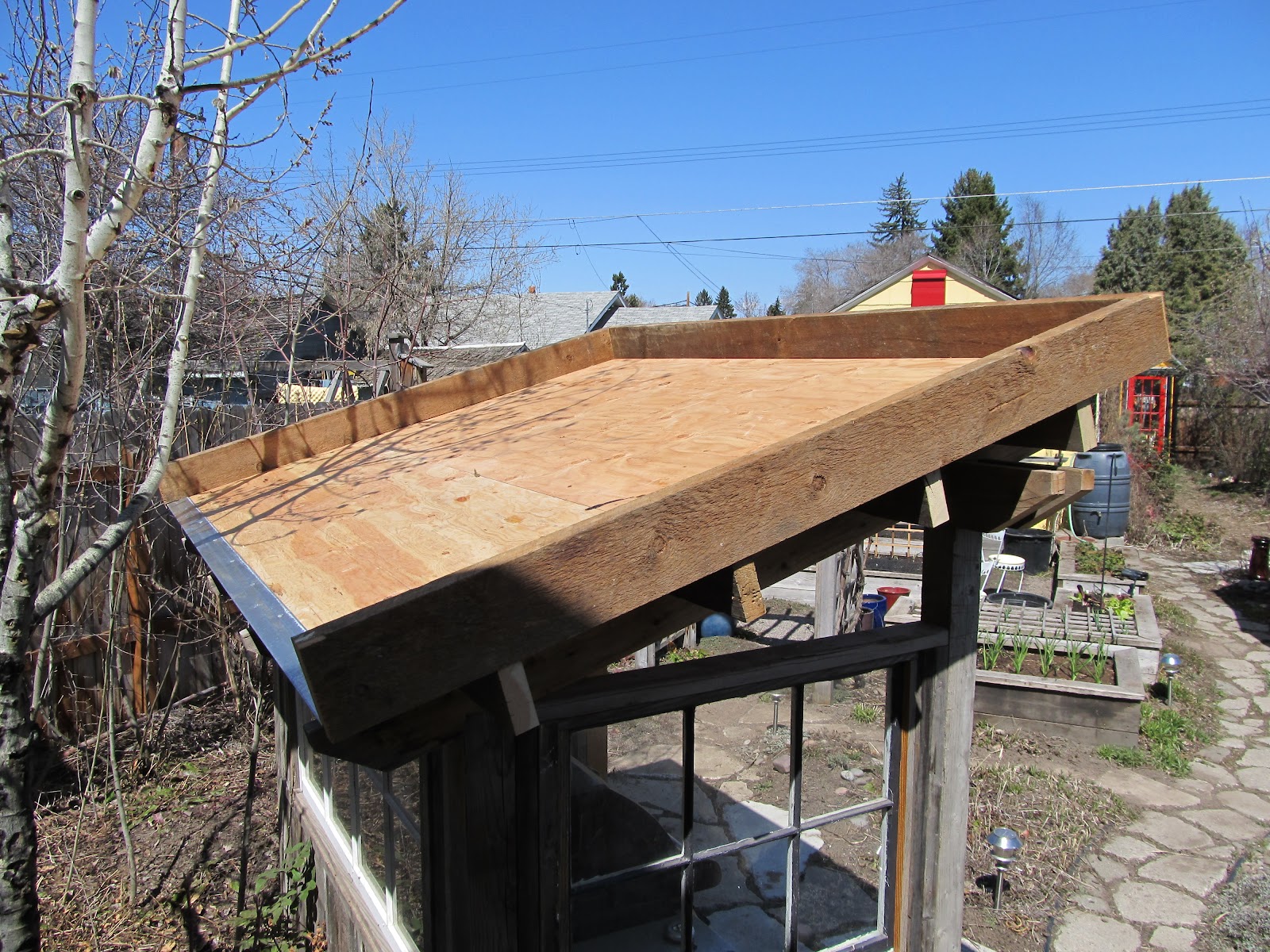
The first step in this project was removing the metal roof (it went back to Home ReSource, where I will probably end up buying it again!), and reinforcing the framing to bear the weight of the new roof.
I added reclaimed 2x5 purlins on top of the rafters, and sheathed the roof in exterior grade plywood.
Then I added a reclaimed metal drip edge,
and framed the rest of the roof with reclaimed, rough cut 2 x 6.

I then installed a self adhesive waterproof membrane- this is the most expensive part of the whole project, but luckily they have a bunch of this type of material at Home ReSource.  After some looking around, I found a lot of options there.  One was a rubber pond liner- this would work great, but I wanted to keep weight down, so I went with the membrane.
On top of the membrane, I laid down landscape fabric, and fully encased the gravel drainage layer. 
I added about 2” of gravel to the roof, and the reason I fully enclosed it was so the roots did not penetrate it, and so the gravel wouoldn’t shift or fall out of the drainage in the roof.
In retrospect, this is a lot of weight.  Although gravel is cheap, I’d look for another alternative for future green roofs.  I know many manufacturers sell plastic drainage layers and that might be the best alternative.  We’ll see.
Soil mix
On top of the landscape fabric I added a rooting media.   There are a lot of differing options and opinions on soil mixes for green roofs, and this is one area I wanted to experiment with. Over the course of mixing it and applying it, I changed the ratio a few times.  My initial plan was to use equal parts of compost, pumice, and perlite.  The whole idea is to have a light weight soil mixture, that has a fair amount of volume for roots, but drains well, and does not contain too many organics.  Although I considered using other materials like sphagnum peat, crushed Styrofoam and others, I eventually ruled them out.  As this progressed, I eventually stopped using compost- I was afraid of too much nutrients for the plants and the compost I also feared might hold too much water (for weight), and I switched to composted bark mulch (soil pep) and perlite.  
This is a really light and loose mix.  I went with 3”, and I think this will work out well.  In the end, it is probably ¼ perlite, 1/3 compost, ¼ composted mulch, and 1/6 pumice.
To hold everything in place while the plants got established, I covered the roof in burlap.  This will breakdown over time, and to plant it, I just cut holes in it.
Plant selection
I really wanted to use native plants for a green roof, and that is how this whole thing got started.  We’ll see how my selection goes, but my goal is to find a mixture that includes a diversity of plant species (read: not all sedum, like many green roofs), for human interest, wildlife (insects and the like) value and aesthesis, low rooting depth (that is, no taproots), fibrous roots that with help to bind the soil, plants that seed prolifically (to fill in the roof), a diversity of heights and textures, drought tolerant, plants that are easy to grow, species that are commercially available, and plants that are relatively low growing.  
Here is what I settled on: 
  • Prairie June grass (Koeleria macrantha), bunchgrass, prolific seeder, deepest root depth of the group
  • Idaho fescue (Festuca idahoensis), bunchgrass, prolific seeder, low rooting depth
  • Yarrow (Achillea millefolium), forms a mat and spreads with rhizomes, tallest plant (when in flower)
  • Rosy pussytoes (Anntenaria rosea) - forms a mat and spreads, their light foliage reflects sun
  • Cutleaf daisy (Erigeron compositus) - these form a low mat and flower for a long time (starting in April)
  • Lanceleaf  stonecrop (Sedum lanceolatum).  I used sedum because it is a requirement on any green roof.  It is mandatory. And they enforce this.  A nice succulent, though.
  •  Elkhorn clarkia (Clarkia pulchella) this is for color- they are annuals, with very shallow roots, but they readily reseed
Plants for this project I got from my own garden, from the UM Conservation Nursery at Fort Missoula and from Kathy at Blackfoot Native Plants Nursery, and the Elkhorn clarkia I grew from seeds from Native Ideals Seed Company.
I'll post updates about the successes (or failures) and we'll see how it goes.