Showing posts with label goals. Show all posts

Tuesday, September 1, 2015

Native Plant and Wildlife Gardening Classes in September!

 
This September, my wife and I will each teach a class through the Missoula County Public Schools Lifelong Learning Center.  We each taught classes last year; Marilyn taught a class on composting, and I taught one on native bees and building a native solitary nesting bee box
A successful class!
We both enjoyed teaching such wonderful and engaged students so much, we will be back!
This time, on September 15, I will be teaching a one evening class on gardening for wildlife, obviously one of my favorite topics!
Here is the description of the class from the Lifelong Learning Center's website:
  • Do you want to create a sustainable landscape that attracts and encourages wildlife? If so, join David as he teaches you to provide all the features to draw birds, butterflies and other wildlife to your garden. This is a one night class where you will discuss the various components of creating an oasis for you and for wildlife in your garden.
Native plants attract insects!

Two days later (on September 17), Marilyn, one of the best native plant botanists in the state, will teach about native plants in the fall, how to plant, what to plant and how to identify.  What a great native plant and wildlife garden week!
Fall colors in the native plant garden
Here is a description of her class from the Lifelong Learning Center Website:
  • Who says it’s time to put your garden to rest? With the right plants and methods, fall is the prime time to create a beautiful color landscape. By using native plants (perennials, shrubs and trees) your fall garden will look beautiful for you and for birds getting ready to spend winter in Montana. We'll discuss plants with late blooms, leaves of all colors, and which shrubs bear interesting fruits and pods. We'll also talk about fall planting methods and how much to tidy up the garden for winter.
To register click here.

Hope to see you at one of these classes!

Saturday, May 16, 2015

Butterfly Properties Garden Tour!

Marilyn and I have been garden coaches in Missoula since about 2009 (Butterfly Properties).  Garden coaching is just what it sounds like: helping people identify garden goals and then helping them achieve those goals in a step-wise strategy.

Our favorite part about garden coaching is seeing how excited people get by transforming their yards from something generic to something beautiful that suits their personal vision and needs. It is inspirational to see! And now we want to share the inspiration with you, via the Inaugural Butterfly Properties Native Plant Garden Tour!

Four of our clients agreed to open their yards for the tour. We think that if you live in western Montana and are interested in native plant gardening for beauty, personal enjoyment, wildlife habitat and resource reduction, you will enjoy seeing these projects. You’ll probably get some ideas and meet some new friends. 

JOIN US!  Click here to RSVP on the Facebook event, or contact us by email by clicking here.

Inaugural Butterfly Properties Client Native Plant Garden Tour!

Date:  Sunday, June 28, 12-4 pm

Location: Begin and end at Butterfly Properties World Headquarters, 1750 South 8th Street
West, between Catlin and Garfield on 8th Street

Tour Description:

Join us as we tour four of our clients’ gardens: gardens envisioned and created by people just like you. Each garden is different: different stages of maturity, different goals, and different site considerations. But what do they have in common? Using native plants to create personal, beautiful spaces for people and wildlife to share.

We’ll meet at our house to hand out maps, meet each other and set up carpooling options. We’ll visit each garden as a group, and hear from the gardeners.  We hope this tour will become a regular event. It is an opportunity to get ideas, inspiration, and motivation and to meet like-minded gardeners.

We will conclude with a social and a recap form at our garden. We will probably have some native plants to give away, too.

Tentative Schedule:

12:00 Meet at 1750 S. 8th St. W. (Butterfly Properties World Headquarters) for map and carpooling

12:45- 1:15 “Downtown Secret Sanctuary”

1:30- 2:00 “Fun Family Space Garden”

2:15- 2:45 “Natural Playground and Family Compound”

3:00-3:30 “Bury the Evidence”

3:30- Social at Butterfly Properties World Headquarters!

Garden Descriptions

12:45- 1:15 Downtown Secret Sanctuary
Our Front Street yard is our sanctuary in the making, a secret garden in the downtown area. For years it was a blank canvas for which we had no vision. Its evolution has been equal parts planned (thanks to Butterfly Properties) and organic creativity. The yard has some unique features that we have tried to use to the best advantage of the garden and which help make it a fun place to explore. There’s a steep hill with a shady grove at the bottom, a sunny ledge near the house, and some structural elements we’ve tried to connect to the garden. We’ve incorporated pathways, dog friendly spots, vegetables, and low-water areas.We are excited to be a part of the Butterfly Properties garden tour, to share our progress and see the cool ways people are designing their yards.

1:30- 2:00 Fun Family Spaces

A year ago we were stuck on what to do with our large, flat, square backyard that contained a small deck, eight huge vegetable planters and far too much weedy, dry lawn. We had almost no gardening experience, and the little we had was in a tiny yard in England.  We wanted to use the space for outdoor eating, for kids to plan and explore, to relax with a book or chat with friends on warm evenings. We also wanted to reduce the time and water inputs required to maintain the vast lawn. Since we met with Marilyn and David last summer, we've planned out spaces for eating, playing, lying in the hammock and socializing. We've removed half the lawn; laid what feels like acres of weed matting and mulch; planted some initial shrubs; built a small sandbox and added a climbing structure; and, most recently, dug a large hole and turned the dirt into a hill. We're very much “in-progress,” but the space has already been transformed – there’s increasing variety and plenty more to come. One real benefit of making drastic changes like removing 1200 sq ft of grass and moving 10 yards of dirt is that it definitely makes the prospect of further changes seem quite manageable.

2:15-2:45 Natural Playground and Family Compound

Our "garden" is actually our entire lot, and now expanding into Lisa's mom's backyard next door. We have a food and cut flower garden and some native plant beds out front but most of our energy and time is spent in our back yard right now. We began working on our landscape plan in 2008! We were initially looking to add some interesting landscape design and start experimenting with natives. At first, we worried if we were keeping enough lawn for our needs, but now we are always thinking about which sections of sod to remove next. The biggest challenge for us is always removing sod--that first sod cutter experience was a marriage test! But with each year we are inspired to keep the project going. Our yard is used for many things including privacy in an urban setting, family gathering space, growing some food, and creating wildlife habitat. Lisa is exploring how the yard can become a testing ground for preschool playground ideas. We want to have a back yard that draws our kids outside and can keep them busy in imaginary play for hours where they can run back and forth between our house and Grandma's.

3:00- 3:30 Bury the Evidence

We wanted a beautiful but low maintenance front yard that let us focus energy on vegetable gardening instead of lawn care. It makes me happy to work in the garden, and it makes me even happier when the garden returns the favor with food. I love vegetable gardening and this is my first stab at working with natives. We started our garden project last June with a visit from David and Marilyn. Their enthusiasm threw us into several weeks of sod cutting, rolling, and Craigslisting. That was followed by mounding loads and load of soil (including our entire compost pile, accidentally stealing rocks from our neighbor, and a deep well I was conveniently digging for our egress window). The project culminated with my mom flying in from Detroit to help me plant all our fresh starts, only to break both of her legs the night we completed the work. We decided that would be a good point to wrap things up for the season.  Our favorite thing about the garden is the mounds David suggested. Not only do they make the neighbors think that we're a little off, but they look really cool with snow on them in the winter when you can't see all the plant babies. Countless neighbors and bike commuters have gone by and made a crack about what we're hiding under the mounds. A mother-in-law? The last person who asked? Cats? You name it.  Removing the sod was ridiculously hard work, but David's method worked like a charm. Not one blade of grass has sprung up. This season we are finding out who survived the winter, learning to identify the native plants, and probably filling in with some new additions.

Finale: Social at the Butterfly Properties World Headquarters

Our garden goals are to use only Missoula area native plants to create places for wildlife and for us. We also think it is important to only water what we eat. Our yard is arranged into a series of rooms- laundry, cooking, dining, potting, and more.

Monday, April 27, 2015

Make a Bee House Class Follow-Up


I had a lot of fun talking about native plants, native insects that use them, and our native pollinators at the Make a Bee House Class I taught last week through the Missoula County Public Schools Lifelong Learning Center.   
Twelve people participated in the class, some had never used a drill, others had never really thought there was a difference between a bald faced hornet, western yellow jacket, European paper wasp, etc… but all were eager to learn and excited about native bees!

Everyone had great questions and I think were pretty excited to install their houses and see who shows up.  I hope people keep me posted about their boxes.  I also know most were eager to build more.  Like I mentioned in the class, if nothing else building the bee houses and watching them is a great way to learn about out native bees and other insects.  

Ultimately the class made 14 boxes, and only a little blood was shed.   

I got all the materials at my favorite building material reuse center, Home ReSource, including Douglas fir 4x4" and 4x6" for the boxes, cedar shakes and tin ridge cap for the roofs, cedar fence boards for the backs and a variety of nails and screws to fasten it all together.  Home ReSource has it all.

This just in....I just got an email from Cate from the class showing where she installed her bee house- right next to her vegetable garden!  Beautiful!
Marilyn, my wife, made a box too (she was a test subject for the class; she survived), and this one will be installed at the Native Plant Garden at 8th and Grant this Thursday when we do a spring cleaning, and weeding of this neighborhood native plant garden.   Everyone is welcome to attend, and we will even be giving out free native plants!  See I was able to turn this post into a plea for help!  Here is a link to the event page with more information, but you can just show up at 8th and Grant, at 6pm on Thursday (April 30), ready for an hour or so of light work in this little garden.  Bring gloves and your favorite weeding tool if you have one.


This box is heading to the Native Plant Garden at 8th and Grant!
The idea of ground nesting bees interested a lot of people and prompted some discussion of what we can do for them (since they comprise the majority of our native bees), and I thought I would pass a long some timely information.  One was a recent blog post on how to provide habitat for native ground nesting bees from my favorite native plant and insect personality, Heather Holm of Restoring the Landscape with Native Plants, and author of Pollinators of Native Plants.  Be sure to follow her on Facebook, and any other social media you can.  And buy her book.  She is a wealth of information on native plants and insects, and a fantastic artist, graphic designer, educator and landscape designer! 

The other experience with ground nesting bees came to me yesterday (unexpectedly) when I was hunting in a snow storm in the mountains east of Missoula.  As I was sitting under a ponderosa pine escaping the cold and wet snow, a bumblebee came buzzing by me visiting some flowering lupines and other snow covered plants.  I immediately thought of how I explained to the class that our native bees will tolerate a much wider range of temperatures and conditions than Eurasian honeybees.  So I took out my phone to get a picture of a bumblebee pollinating flowers in the snow.  Then the bee landed on a patch of bare ground and started furiously digging, probably a excavating nesting burrow.  I captured this action on camera:


Wednesday, August 20, 2014

Bird list

Although I’ve been spending a lot of time posting on this blog about birds, and spending time in the garden watching birds, it has been our new chickens
However, after a social at our garden, I was reminded it was time to update my garden bird list. After some investigating, I realized the bird list on my blog had become woefully out dated (and I realized I was not the Montana "Chicken" Gardener, but the Montana "Wildlife" Gardener). I hadn’t formally updated the bird list on my blog since about 2009. 

Despite that I spend a lot of my time at work building, maintaining, accessing and editing databases, evidently my bird list is not in one! So, after some copy and pasting, and tediously searching my blog, I have revised my bird list. And here it is.

For those interested in exclusively the number, that number is 71.


Some details about my bird list, this list probably under-represents some species (like flycatchers- I don’t even really try with those!), and I only count birds that use the garden. That is, I don’t count fly-over’s, or even birds I can see from my yard- they have to be doing something like scratching on the ground, gleaning insects from leaves, bathing, nesting, eating one another, etc… To me flyovers are just happenstance- they do not reflect what I am trying to accomplish in the garden, that is, to create habitat for a variety of wildlife using plants native to the Missoula area.


I was struck by several things after reviewing the list.

  1. Apparently I need to spend some time reading my own blog. This year I remarked that the vesper sparrow as a new arrival in the garden- they same way I made that proclamation in 2010. 
  2. Birds that were once annual common like common redpoll and pine siskin in the winter, I haven’t seen in 10 years. 
  3. A lot of common, local birds aren’t in the garden, and some uncommon local birds are. 
  4. If I counted fly-over’s, I would have a lot more birds on my list (bald eagles, red tailed hawks, osprey, great blue heron, turkey vultures, red tailed hawks, Canada geese, canvasbacks, blue winged teal, mallards, California gulls, etc…) regularly fly overhead. Even rock doves. 
  5. I grudgingly acknowledged the trash birds- the one’s I try to keep out; house sparrows, Eurasian collard doves, and European starlings in this list
In all, it is pretty cool to see this list. I can remember almost every one of these species, and I am really excited about attracting them to our little garden on 8th Street. And it all comes down to the fact that birds eat insects, and insects need our native plants.

Sunday, August 10, 2014

Chickens

The coop is complete, and full of chickens.

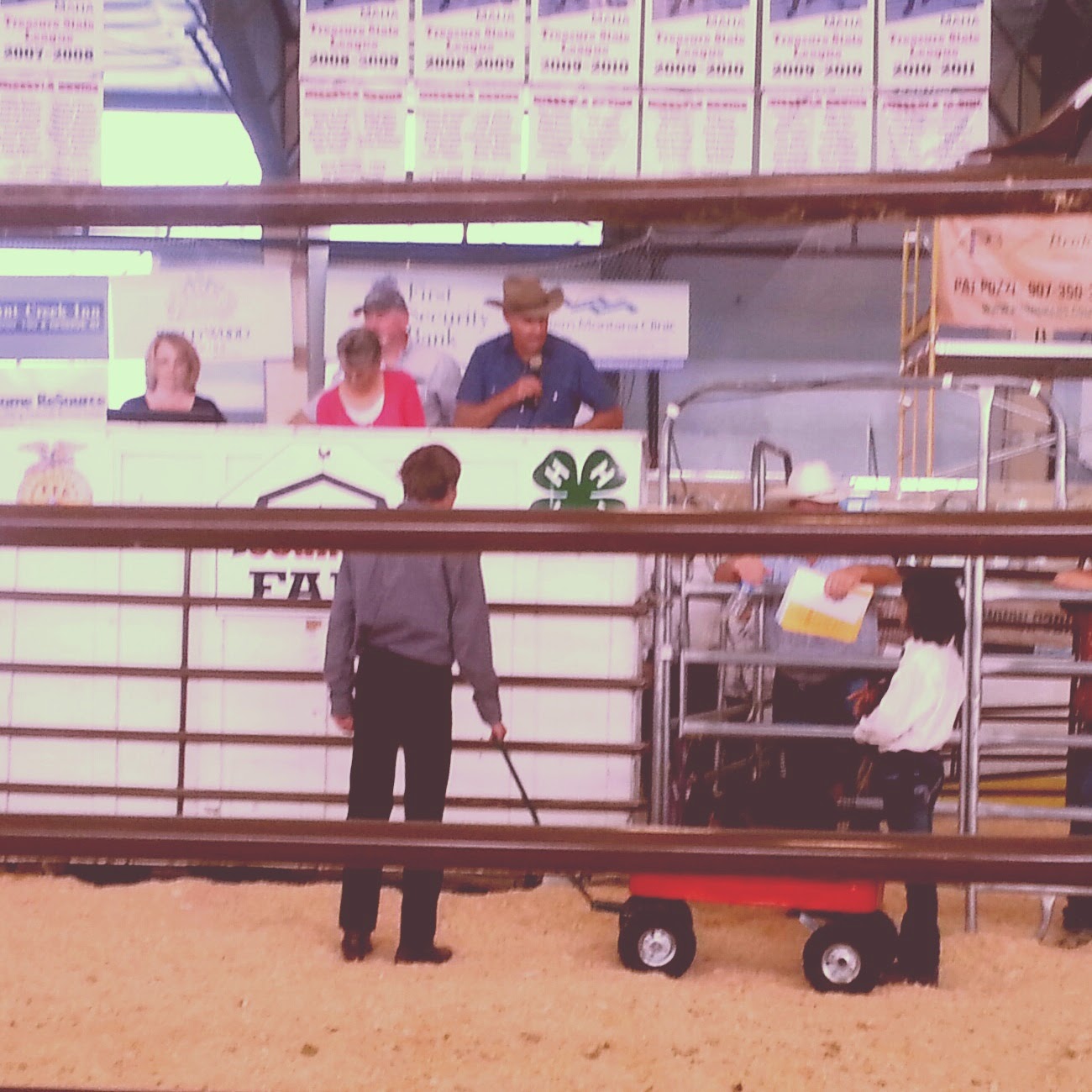
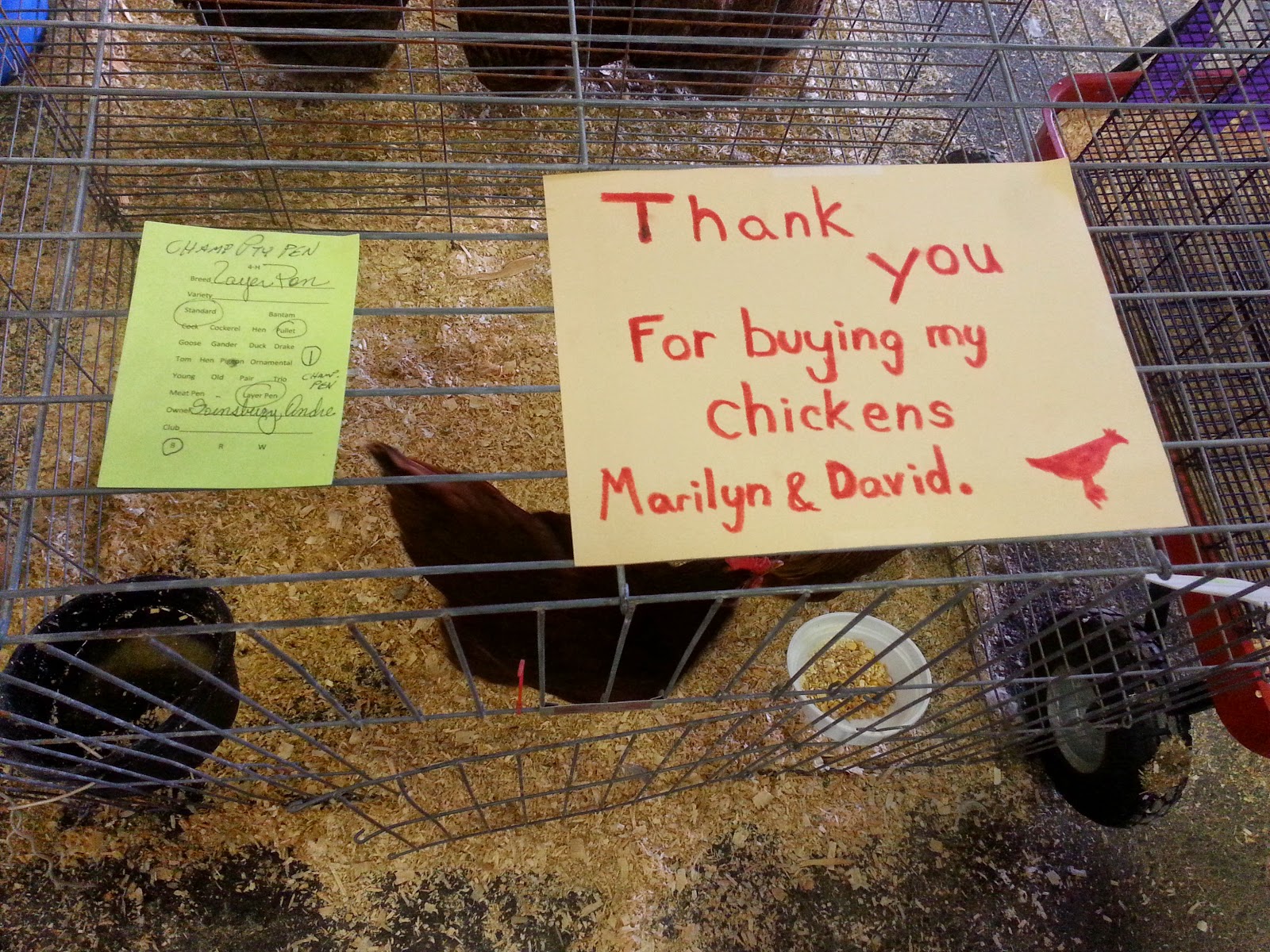
We were the highest bidders at the 4H/ FFA livestock auction on the GRAND CHAMPION layer pen!  It was an exciting day.  Not only did we get some beautiful Rhode Island Red hens, had fun at the auction, but we got to support 4H and some young livestock producers.  My wife was in 4H when she was young (she raised steer) and has a lot of very fond memories of it, so it was really gratifying for us to be on the other end of the auction and be able to buy some animals from kids.
If you have never been to a livestock auction, and in particular a 4H/ FFA auction, you are missing out of such an important part of the community.
The auction was a lot of fun- it was a great and supportive crowd full of local business people supporting the kids and the organizations, the auctioneer was excellent and the spotters were super engaged.  It is wonderful to see the kids with their animals, and the fair and auction represents a culmination of months of work.  All, when asked what they were going to do with their money, said "it was going toward savings".  It makes you feel good about the world.
We were only looking for two hens (based on space and the number of eggs we eat), but we ended up buying a pen of three, now we have to decide what to do with the third.  We asked about donating it back to the auction, but that was forbidden.  So I think we are just going to have three hens.  Perhaps expanding the run, too.

So, are these backyard chickens and example of sustainability?

These chickens will provide us with local eggs, and we can control how they are kept and fed, which is nice, but fiscally, this endeavor is not sustainable. I have enjoyed designing and building the coop, and the opportunity to support 4H has been great.  Between the cost of the annual permit, building materials, the Grand Champion layers, it will take us roughly a decade to save money on eggs!  We don't even eat many eggs.  However, we have met our goals on this one.
Proudly displaying our framed chicken permit in the coop.  It has only been recently (2007) that backyard chickens have been allowed in Missoula, and like most things in Missoula, the passage of an ordinance to allow up to six hens was controversial.  Like roundabouts and most things that are proposed, opponents actually said, that if passed, this would kill many children (I am not making this up).  Like the roundabouts, and backyard chickens, they passed. My wife was part of the city council then (and now), and a strong supporter of this ordinance when it was adopted.  So, when I say the permit is proudly displayed, I am proud as a chicken owner, but really proud of my wife's work on council for so many things, including this ordinance.

Here are some pictures with some more coop details:
 On top of the run is a green roof where I planted strawberries.
 Miles (our wired-haired Chihuahua) does not know what to make of the new residents.
 A couple of the roosts.


Yes, I embellished the rafter tails by cutting eggs...
it only made sense after cutting a hen-shaped vent.

Monday, October 21, 2013

Garden project progress- Home ReSource fencing


Although it is getting late in the gardening year, I am making some progress now on some garden projects- primarily fencing related.

This fencing project started about 11 years ago.  When we first bought our house, the house was surrounded by a dilapidated 4' staggered board fence that provided little privacy.  Over the course of a couple of summers, we replaced 2 of the 3 side of the fence as time and money allowed.
The third side (the east), I frankly never thought I would ever complete, though periodically over the years i threatened to finish it.

Then it happened, while shopping at Home ReSource one day someone dropped off about 130 lineal feet of 6' privacy fence panels- more than enough to complete our last side.

I was there on my bike and I didn't want to deal with buying, loading, unloading and storing all those fence panels so I just tried to ignore that it was there.  Later that day I returned to get it, because I couldn't stop thinking about how I should get it.  When I got back, about half had been sold.

I bought the rest and for the last few months I have been moving those panels around- each place I put them turns out to be a place where I need something else.

Over the last two weeks, panel by panel I have been replacing the old fence with the new.  I actually just set out to pull out the old fence posts and dig new holes before the ground froze- bargaining.
One thing lead to another, and I now have two new gates, and 90% of the east fence complete (I ran out of materials!).
As for the old fence, Marilyn neatly de-nailed, sorted and stacked all the old cedar fence pickets and cedar 2x4 rails.
I'll eventually reuse all these boards into trellises, garden furniture and other things.

Replacing the east side fence was just the beginning.  Having all these fencing materials on hand helped me address some other problems that have developed over the years.

Over the years, our use of the backyard and our needs have changed.  We no longer need a 10' double door to the garage (my shop), and it is saggy and hard to use.  Now that we don't even have an overhead door in the garage, we don't need a double gate int he fence to access it.
So, I replaced that double gate with a single 40" wide gate that opens both into the alley and bakyard.  It is much easier to use, takes up less "floor" space,


And, the feature I like most is that I installed a deadbolt lock (from Home ReSource) as a latch that I can open from the alley (I had it keyed to our house key).
All the hardware was from Home ReSource, too.
Plus, this gate incorporates not only parts of our old fence, but our old hammock stand, too, like the curved top and bottom rails.
Though we don't need a big gate to the garage, we do need a big gate to get the camper in the back yard.  You can follow the renovation of our camper on my wife's blog http://toastercamper.blogspot.com/.


I considered a lot of different options for opening and closing this 11' gate from two doors on hinges to an 11' rolling or sliding gate.  I eventually settled on the low tech (and cheap) option of just making a removable panel on hangers I got at Home ReSource.

So, as our use changed, so did the fence, and gates.
It is very gratifying to reuse everything you can.  The western red cedar lasts a long time and has a lot of life left in it (both the new fencing and the old), but I reused everything I could from the fence panels and supplies I purchased, including 2x4's, pickets, and screws.    The only thing I bought new for this project is pressure treated 4x4's and concrete.
My old gate hardware is going to a friend for his gate project, and anything I don't plan on using is going back to Home ReSource, where it can be used again.

Tuesday, August 20, 2013

Don't be afraid to change; change is a constant in the garden

The hammock stand is dead.  Long live the hammock.
A garden is not permanent.  Plants grow, they die, and your interests and needs change.  Fortunately change can come easily in the garden- your landscaping does not have to be forever. The notion of permanence often paralyzes people into never beginning. But in a garden, if you make a mistake or things don’t work out like you expected them, you can change it!  I know this from experience.  You can move plants, compost them, give them away, etc… It is much easier to remove your landscaping than remove a room inside your house!

This new change in the garden is an example of a few things my wife and I often tell our garden coaching clients:

Write down what you need in your garden, and you will incorporate it appropriately. Whether it is canoe storage, bike storage, a raft, chickens, no matter what use, acknowledge that it has a place (and it deserves a place) and you can integrate it into the garden to aesthetically fit in and functionally become part of the garden. We see this all too often that there are hobbies or items that people want to have in their garden, but for whatever reason they don’t want to think about so they don’t get incorporated, and just get pushed into a corner. There, they don’t get used and it doesn't look intentional. It is like a well organized house, but with a pile of clutter in the corner (Like, between a dresser and a wall. Marilyn.).

Furthermore, it is all these components that will help personalize your garden and make it a reflection of what you like and the things you do- it will be a reflection of your lifestyle. I wrote a post a while back describing our garden as a “lifestyle” garden- a name given to our garden by a local nurseryman, and a name I have come to really like.

Plan for how you will use your garden, and you will use it more. When we began landscaping our yard we didn’t have a camper, now we do, and this will add a lot on interest to the garden while providing, if nothing else, functional storage for the camper in the off season. Again, uses and interests change over time; change is the only constant in a garden.

Have fun, try new things, and if they don’t work, re-do it!
The hammock stand was a fun project to build and beautiful to look at, but frankly, it did not get much use. I built it for my wife-  I don’t really like to lounge in the garden (this may come as a shock you many of you). Our first hammock was made of cotton so I got it for her for our 2nd anniversary (cotton is the traditional 2nd anniversary gift). The hammock pergola took up a lot of room in the garden, and room we could use for other things and other things that would get more use. 

We have a small yard, so using space efficiently is important (and a fun challenge). I have always maintained we could live in a smaller house and a have a smaller garden and we’d be fine. There are still many places in our small garden that I view as just filler- plants acting as place holders until I figure out a need or use for the space. These are what I call opportunities.

A new new gardening opportunity
This past weekend I dismantled the hammock pergola, stacked the wood, sorted and organized all the hardware (screws, lag bolts, and washers), and began planning to new pergola, which will reuse most of the wood. This Wednesday evening, friends will come over to dig up native plants for their own gardens and hopefully take away some of the hills, too. And come to think of it, I should have them dig post holes for the new pergola!

I am excited to re- landscape this and incorporate our 1966 Security Traveler into the garden.

Wednesday, February 27, 2013

Upcoming Speaking Engagements

Spring is nearly here and people are thinking about their gardens.  This spring and summer I have a few speaking engagements across the state.

The first one (pictured above), is sponsored by the Calypso Chapter of the Montana Native Plant Society and University of Montana Western's School of Outreach.  I have had the pleasure of speaking to this group in past years and I had a wonderful time with the very interested and engaged crowd.  RSVP soon- space is limited and it typically fills up.  Contact outreach@umwestern.edu to register or for more information.

Date:  April 6
Location: Beautiful Divide, MT at the Grange Hall
Topic:  Insects in the Native Garden


Next on the list is a little more vague- I'll be doing a presentation with the Montana BOW (Becoming and Outdoor Woman) program (a program I am a huge fan of), and we are thinking of central or north-central Montana- tentatively in Lewistown or Malta, sometime between May 1 and May 15.  As you can see, there are still some details to work out.  Contact Liz Lodman for more information (or to lobby for a location!).

The next presentation is a combination presentation and field trip to our garden.  This one is also part of the BOW program, and is part of summer BOW.  Summer BOW is a wonderful experience, if you have ever thought about learning to fish, shoot, hunt, identify birds, navigate in the woods, or learn about native plan gardening (!), and you are a woman, consider taking this workshop.  Montana BOW is such a fantastic program and I really enjoy participating any time I an invited.
Sign up soon- summer BOW fills up quickly!  Contact Liz Lodman for more information.
Date:  Aug 2-4 (my presentation and field trip is Aug 3)
Location:  Lubrecht Forest, Greenough, MT

Hope to see you at one of these presentations!
Think gardening.

Tuesday, September 25, 2012

A new project: buy nothing made in China for 1 year

This might not sound too much like a garden blog post, but it most certainly is.  Our garden- the landscaping and vegetables we grow is our attempt at living lightly.  The goal of trying to buy things more locally is an extension of that attempt.  There are many reasons for not buying things made in China, ranging from human rights concerns, to the distance the items have to travel, to supporting local businesses, and I'm not going to elaborate on them here- others have said it better.

This project of mine started a month or so ago when I needed to get a new angle grinder (a tool for the shop).  Normally, I try to buy tools used (for cost reasons, because many things have a longer life than people think, and also for the fun of it), but angle grinders are one tool that just wear out and are not a good investment used.  I started looking at the usual American brands: Milwaukee, DeWalt, Porter Cable, etc... and these were all made in China.  I kept looking, and I was surprised to eventually learn that THERE ARE NO ANGLE GRINDERS MADE IN THE USA ANYMORE!  So, I broadened my search and looked at Makita (a Japanese company)- their grinders are also made in China.  I eventually purchased a Metabo grinder (made in Germany).  Kind of shocking that was the best I was able to do!

So, I thought, I'd pay better attention to where everything I was buying was from, and for the next year, I will try to not buy anything new from China (not just tools for the shop, but anything).  I'd like to only buy stuff made in the USA, but from the grinder example, maybe that is not possible anymore.

I'll keep you posted how I do.

Friday, September 7, 2012

Hot and dry in the wildlife garden, and just the way I like it

It’s been a dry one this summer- throughout the west.  No surprise, I know everyone has been dealing with it and hearing about it.  In Missoula we received 0.04” of precipitation in August* (for those of you scoring at home, that is 1.0 mm).  Not a lot of moisture and that is the same amount as our home garden received, and I wouldn't want it any other way.
Now is the time I think native plant garden shines- this is the reason we have selected locally appropriate species- a suite of plants designed to handle these situations- without any interference or assistance from us.  Make no mistake- it is dry, and we have received only a fraction of normal moisture this summer (normal for August* is 1.23”, and probably going down).  I never gave a thought to watering, and I’m not worried about the plants at all.
For a variety of reason, I’ve been digging some holes in the garden- to transplant some plants, dig post holes and remove some plants.  In each case I was amazed by how little soil moisture there is.  None.  Yet the plants survive, and even thrive.   Although many plants are dormant, even if prematurely for the year, not all are. The rubber rabbitbrush (Ericameria nauseosa) is just starting to flower, and some of the fleabanes (Erigeron species), are re-flowering; a sign of reverse photoperiodism.
Early dormancy is a common strategy for dealing with the unusual hot and dry conditions.  It happens in the wild and in our garden- there is a nice harmony and symmetry with that.  It helps me feel connected to the natural world.  When I was elk hunting this weekend, the plants looked the same there as in my garden.  And actually, many in my garden looked a bit more lush.  In the woods right now even the serviceberry (Amalanchear alnifolia) have either lost their leaves or they have turned brown.  All, save the plants in the riparian areas that will stay lush and green through the fall.  We live in a water limited environment here. 

I don’t really understand why people plant native plants- wanting the benefits of water conservation, but then water them like conventional plants, or expect them to look like they do in June all year long.  That is not how it works, and not how these plants have adapted to our local ecosystems.  Trying to change this aesthetic just reminds me as a group native plant and wildlife gardeners have only come so far.  We need to accept the beauty in the natural world, and the values and aesthetics of something different than an emerald green lawn, and roses and annuals flowering in the end of August (when we have only received a millimeter of precipitation).
The garden is dry and beautiful and next spring it will be alive and well, and set up beautifully if we don’t have any more rain next summer.  And the insects, and birds will be back and there will probably be more of them to enjoy the garden again.

*weather data according to weather.com 

Monday, August 6, 2012

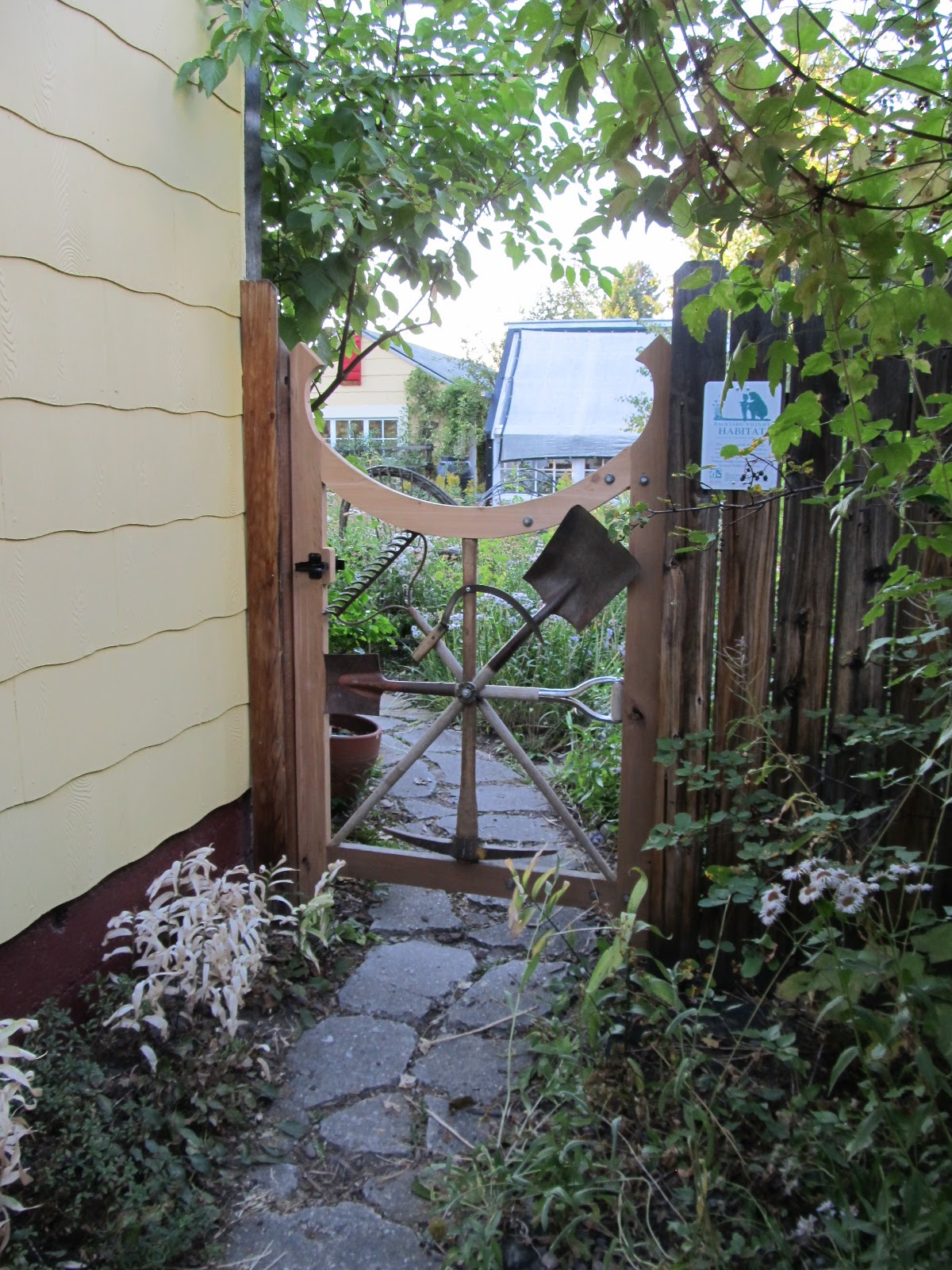
a repurposed garden tool, garden gate

Here is my latest project- a repurposed garden tool, garden gate.  If you recall, this is not on my prescribed list of garden projects for 2012, but this project actually represents me creeping up on a bigger project- a fence for the front yard.  It is kind of a long story how, but trust me, I am making progress on that project, slowly.
Before- a fine gate.
This gate is a replacement for a perfectly good gate I built about 12 years ago.   There is nothing wrong with this gate, but it was not really interesting, nor was it especially inviting.
After- an interesting and inviting entrance into the garden.
Thinking back to 12 years ago in the garden, the gate basically describes the garden, too.  There was not a whole lot going on, and the main objective was to gain some privacy.  
Now that the garden has matured, privacy is provided by trees, shrubs and other structures, and the old gate seemed like an unwelcoming impediment to the garden beyond.
So I took this as an opportunity to add a little creativity and art to the garden, while at the same time, opening up the backyard and connecting the side yard to the back.
As with most of my projects, all the wood (cedar 2x stock), garden tools, and hardware were all recycled and came from Home ReSource (have I mentioned I enjoy shopping there?).

Using garden tools seems fitting as both an entrance to the garden, and to describe the hobbies of the homeowners.
This gate is just down the path from the new trellis I made earlier this year, and there are obvious similarities.
 I think this gate provides a sense of separation, yet allows a nice flow or continuity to the garden.
In case you are wondering, the old, perfectly good gate won't go to waste.  I am going to reuse the screws and cedar fence boards, and the frame and other hardware I'll donate to Home ReSource (where I will probably end up buying them for another project someday!).