
Here is a brief update of a project I completed earlier this spring- a small makeover to our front yard prairie, and a couple of pictures of what is flowering now (above is sticky geranium, Geranium viscosissimum, this is easy to grow, and quick to flower- unlike the species pictured at the end of the post) .
I moved the front path (taking my own advice), added a hill, and added some interpretive signs. The whole point was to correct some design shortcomings and embrace the public-ness of our front yard. This project was also a great opportunity to eradicate some weeds that have been difficult to control (Kentucky bluegrass, Poa pratensis , in particular), by digging up a couple of big sections.

All the plants we installed in the new area came from other places in our yard. I have a lot of fun digging up plants from our yard that are volunteers in the cracks in the sidewalk and other places, growing them in our nursery for a couple of weeks and planting them elsewhere int he yard. Most of these plants can from the area that our greenhouse now occupies.
Below is a picture of death camas (Zigadenus venenosus), a pretty severe sounding name. I hear it is not really deadly, but it will just make you sick, but I am not going to try it. It is a really neat little plant, and looks a lot like a tiny bear grass (Xerophyllum tenax). It is really easy to grow (provided you can get the bulbs). We initially got ours from some plant salvages (plants we rescued from a development in Missoula), but since them, they have seeded well and we have a lot of volunteers.

As far as design elements, our front path has always annoyed me- a straight line leading right to the door. Similar to the back yard, I broke up the concrete and rearranged it to a curving and wider, more inviting path.

Adding the hill added topography and some visual interest, and also helped to obscure the front entrance a little. This hill also provides a nice place to showcase 30 or so bitterroots (Lewisia rediviva) that I transplanted from our backyard when I dug up plants to install the greenhouse.
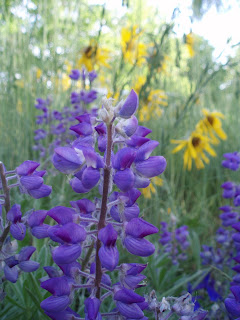
Below is a (I think- my wife might correct me) silky lupine (Lupinus sericeus), and in the background is arrowleaf balsamroot (Balsamorhiza sagittata). Both are easy to grow, but as I mentioned here you need patience 4-7 years before that flower, and don't try to transplant them- their taproots are huge!
Since our front yard is a marked departure from the typical turf grass monoculture and token specimen trees so familiar to the urban/ suburban landscape, the addition of interpretive signs helps to explain what our landscape goals are. In the past, we have had signs that identify plants and signify this as a backyard wildlife habitat, but these new signs go one step further and explain Missoula prairies, wildlife gardening and why we do not have a lawn.
 Below are two pictures of our front yard prairie, the top one is before (May 2005) and the bottom one is after (May 2009) this little makeover project. Not a huge change, but I think it is substantially better. I really enjoy small changes and rearranging elements in the landscape.


 It was a busy weekend. Since the last construction update, I completed the exterior and began finishing the
 By moving a couple of hills, creating a path, moving some plants around, rearranging the furniture and a lot of tree pruning, I created a more comfortable, interesting and intimate dining room. The path (on the left in the photo above) does go around to the front of the greenhouse, but it is more a of design element that suggests more depth, space and creates some intrigue. Like all paths it directs your eye and helps you move through the landscape and leads to an active interaction with the landscape.
  I am really happy with this change, but the most important lesson I think is that change is possible- don't be intimidated, you can move plants and rearrange elements in your garden a lot easier than moving walls in your house. I really enjoy rearranging things in the garden and trying something new. It is free and can be really gratifying and spatially satisfying. Anything can be undone and redone in the garden, it just takes some work, and time, but that work is really the fun part or gardening (to me).
 The greenhouse is starting to take shape. Here are a few pictures from today. There is still a lot left to do, but it is nice to see the progress. These are not the final colors (except the white window sashes)- since this is made from re-used


 Lupine species (including Lupinus argenteus, and L. sericeus ) share many of the same traits as balsamroot: long-lived, beautiful, common, showy, and nearly impossible to transplant. Again, they are very easy to grow from seed, but it, too, does not flower for 4 or 5 years. Also, our experience is that even though getting seeds started is easy, survivorship until flowering is low.


 Hopefully this weekend I will frame the gable ends and even the rafters.