OK, so I am starting to get the idea that this Facebook thing is here to stay. I am not saying it will last, but apparently as of Feb 2010, over 400 million people were using it. I was not one of them. However, on a recent trip to explore the unique flora and fauna of the remote rainforests of Guyana, I learned my naturalist guide from a village of about 250 people, uses Facebook, I thought my blog and I should probably try it, too. Now you can follow Montana Wildlife Gardener on Facebook. Thanks, Alex Honorio.
Landscaping with Montana native plants for Montana native wildlife, and gardening for a sustainable lifestyle
Friday, March 11, 2011
Montana Wildlife Gardener is now on Facebook
OK, so I am starting to get the idea that this Facebook thing is here to stay. I am not saying it will last, but apparently as of Feb 2010, over 400 million people were using it. I was not one of them. However, on a recent trip to explore the unique flora and fauna of the remote rainforests of Guyana, I learned my naturalist guide from a village of about 250 people, uses Facebook, I thought my blog and I should probably try it, too. Now you can follow Montana Wildlife Gardener on Facebook. Thanks, Alex Honorio.
Wednesday, March 9, 2011
The buttercups are there- waiting
Friday, February 18, 2011
Flathead Chapter of the Montana Native Plant Society Landscaping with Natives Talk Wrap Up
Click here to download the list of easy to grow versatile and diverse native plants.
Here are some past blog posts that might be helpful:
- Deer resistant native plants
- How to build a native solitary nesting bee house
- Bird house basics (remember, it is national nest box week)
- The inconvenient truth about wildlife gardening: Squirrel control
- Cats and Wildlife Gardening
- The ecology of quaking aspen in our yard (and click here and here for follow ups)
- How to remove your lawn
- Important plants for hummingbirds
- Growing a bird garden- a link to download the Montana Outdoors article
- How to build a brush pile
- Native plants are better than exotics for attracting insects and birds: homeowners are integral to conservation
- Prairie-style gardens- Lynn Steiner
- The American Meadow Garden- John Greenlee
- Front Yard Gardens: Growing more than grass- Liz Primeau
- The Magic of Montana Native Plants: A Gardeners Guide to Growing over 150 Species from Seed- Sheila Morrison
- Bringing Nature Home- Douglas Tallamy
- Shrink Your Lawn- Evelyn Hadden
- Noah's Garden: Restoring the Ecology of Our Own Backyards- Sara Stein
- Paradise by Design, Native Plants and the New American Landscape- Kathryn Phillips
- The Forgotten Pollinators- Buchmann, Nabhan, and Mirocha
- Landscaping Ideas of Jays- Judith Larner Lowry
- Gardening with a Wild Heart -Judith Larner Lowry
Sunday, January 30, 2011
It's time to clean the nest boxes; spring is almost here

I took a break from shoveling snow to do some annual cleaning of the bird houses. This is a post I write about annually, but it is always a good reminder.
For more information about cleaning details click here and for more information about bird houses click here, and for some general bird stuff on this blog click here
Bird nest boxes need to be cleaned and inspected annually. It is a good time to look for water damage, and a good opportunity to inspect the boxes to see if they need any other repairs. At the minimum, remove the old nesting material, scrape off any mildew, and repack if you will be packing the house with saw dust (see here for more information).
I used to clean and re fill them right after the nestlings would fledge, but now I usually wait until early February to clean and refill the bird houses. I don't know if it is because of wisdom or laziness.
If left empty through the winter, birds may use the empty boxes as roosts. For example, this winter when we had several days below -10 F, flickers roosted in the flicker box and chickadees roosted in the chickadee boxes. However, in the past, squirrels have roosted (albeit temporarily) in the flicker box. But let’s just say that squirrel won’t be telling any of his friends about that warm spot to spend the night. Anyway, I digress, another reason to leave them empty after the nestlings fledge, is that our chickadees typically have two clutches and they will build their second nest right on top of their first nest.
Nevertheless, the sooner you get them repacked, the sooner you can watch for excavation activity. It is always amazing how quickly they start checking out the boxes, especially if we get a few warm days, and the little birds' thoughts turn to love.
Here are some important dates on nesting activities in the Missoula area from my backyard:
Red-breasted nuthatches are the first to begin excavating their selected box- they begin excavating in early to mid February (between February 5 and 21 at my house) and they are usually complete by the first week of April (April 1-9) when they begin to fill their boxes with nesting material.
Black-capped chickadees start excavating about a month after nuthatches, with peak excavating around first week of April (from March 25- April 4), until middle April when they bring in nesting material (April 11-15). But they investigate and start defending nest sites in February.
Northern flickers are on a similar schedule as chickadees and they begin excavating in late March – early April (March 24-April 8), but they search for nesting locations in February and may do some exploratory excavating as early as the beginning of February.
Monday, January 24, 2011
2010 Cat of the Year: The story of June bug

I have to say, though, I voted for Alex. Three times.

I love all the cats deeply, and clearly June has the saddest story, but sometimes I feel most for Alex. Alex is very quiet, he doesn’t even purr. When we adopted him, he didn’t even know how to be a pet. His major problem is that he has systematically been ignored. He is small, but not the smallest and his size might be from neglect or malnutrition.
He does nothing wrong (save a few midnight toe bites), and inevitably gets ignored. Even in the post on our cats on a Missoulian reporter's blog, Missoula Red Tape, Alex got left out of the headline ("Vote for June bug! And Squeak! and Natalie!").Thank you to everyone who voted. I especially appreciated all the thoughtful comments, some were a riot. It is clear that readers of Montana Wildlife Gardener took this responsibility very seriously.
The story of June bug:
This competition turned out to be the story of June bug, and here is a little more background.
As far as we know, she was kept in a dog crate (not kennel, but crate) outside for 8 years. The reason started from her poor litter box use. The previous owner even put her in a diaper, and then ultimately a crate. Outside.
When she was surrendered to the Humane Society the staff was shocked by her appearance and health. The intake form read simply “rough shape”. She had to be completely shaved. She had ticks, fleas, internal and external parasites, a mouth full rotten teeth and infections from the flea and tick bites, and only weighed about 4.5 pounds. Frankly, given her age and condition, I am surprised they kept her alive.
After years of neglect and abuse, she stopped grooming herself.
I first saw June in a description on the Internet, I forwarded the link my wife the link and we decided we had to go see her. We went to the Humane Society and were told she was sequestered in a cage in the staff bathroom (the same place we got Squeak! pictured below).

This was clearly a good sign. "You had us at 'bathroom'," my wife quipped.
When I picked up this tiny, bony, but surprisingly hot, little thing, she started to purr. It was from her purring, I was convinced she was a cat (and that was about the only thing that lead me to believe she was feline- see the picture).

She spent the next hour on me and my wife getting petted and given attention. The staff remarked that this was the first time she’d been loved. It only took us a minute or two to realize that she had to come home with us. However, it would be weeks before she could come home. She had to get dipped for various ailments and could not be exposed to our other cats. So, since we couldn't take her home, every couple of days I’d go down to the Humane Society and carry her around and pet her. She purred when I’d open the door to her room and she’d purr and drool on my lap.
We got her home, slowly introduced her to the other cats, and made her comfortable in her own room. She ate and purred and ultimately put on a pound. Her health though was still really shaky, and we made many more trips to the vet, almost weekly.
Her teeth continued to rot, and we found out she was allergic to her own tooth enamel. The vet pulled all but two of her teeth and we give her daily doses of antibiotics.
She suffered signs of stress and anxiety, and we give her Prozac daily. Her years of abuse have clearly taken their toll. All the trips to the vet made us realize that we might not have her very long, and that she was clearly not a healthy cat. We resigned ourselves to fact that maybe all we were doing was providing her with a comfortable place to live out her life, however short that might be.
Nevertheless, she continued to follow us around, sleep on us, and purr. And eat. She has the biggest appetite of any of our cats, even the 15 lb Natalie (or "Fatalie" as my friend Trisha calls her, lovingly of course). For the record, Natalie is big-boned.
June's hair grew in, and it was the softest fur I have ever seen. Evidently her guard hairs did not grow back. As a result, her coat quickly got incredibly matted.


Upcoming Native Plant and Wildlife Gardening Talk

Do you live in the Flathead? Or, if you don't, and you'd like to take a little trip, join me at the monthly meeting of the Flathead Chapter of the Montana Native Plant Society, on February 16th. This meeting will be held at 7 pm. at Discovery Square, 540 Nucleus Ave. in Columbia Falls (the old First Citizen’s Bank). My talk "Conservation Gardening: Landscaping with Montana Native Plants for Montana Native Wildlife in your own Backyard" will show how native plant gardening can be fun, educational, sustainable and meaningful.
Wednesday, January 19, 2011
2011 Garden Projects
- Move current occupants of area that will become raised bed to front yard. Done, and this worked so well, I added a new raised bed in front of the greenhouse- a garlic bed
- Reduce bluebunch wheatgrass (Pseudoreugnaria spicata) in front yard and replace with displaced plants in the area that will be occupied by the new raised bed. Done
- Remove one Steuben blue grape vine (we have two vines that produce over 50lbs of grapes/ year. That is a lot of jelly) and replace with a Himrod (seedless table grape). In the photo above one of the grapes is going for a ride. Done. The Steuben blue has a new home at my friend's house in Idaho.
- Install cameras in bird boxes and connect to Internet. Done
- Complete outdoor grill shed (all I need is to install the roof, so I am waiting for someone with galvanized delta rib roofing to remove theirs and donate it to Home Resource).Done
- Remove one section of lawn and replace with natives like hairy golden aster (Heterotheca villosa), yarrow (Achillea millefolium), showy fleabane (Erigeron speciosus) that I will mow to form a meadow.
- I liked this so much, I got rid of the last vestigial lawn patch,
and replaced it with more flowers and an urbanite path.
- Prune clematis on garage. Done, but I have to do it again. It is a bigger job than you'd think.
- Start a bunch of native plants in the greenhouse to add to our front yard to replace some bluebunch wheatgrass and blue flax (Linum lewisii). Done. See the Elkhorn clarkia (Clarkia pulchellum), in the photo below.
- Make a new compost bin? Not completed in 2010
- Make a new 3 bin composter
- Plant some trees in decadent aspen stand. I am thinking mountain ash (Sorbus scopulina), but we'll see. The aspen have performed admirably, but it is time to move on. Plus, we have the same number of aspen in our garden, they are just in different places.
- Prune the white clematis (Clematis ligusticafolia) on the garage, again a bigger job than you'd think.
- Rearrange some plants in the front prairie, including getting rid of a green rabbit brush (Ericameria viscidiflora) and adding more shrubby trees close to the house
- Replace urbanite in front of the greenhouse and on the side yard that has settled too low. Replace it with larger chunks. It became painfully obvious this past week that these low spots were too annoying to live with
- Start some native plants in the greenhouse. Always a good goal. I want more sticky geraniums (Geranium viscosissimum) in the garden (photo on the top of the post).
- Make a "cut-off" trail in front of the onion bed. The area near the grill shed is kind of a congested area in the garden and by adding this new trail/ path, people will be able to flow better.
- Stream 2 nest box cameras simultaneously this year. Last year I streamed the chickadee camera, and later the flicker camera. While I am at it, maybe I should invest in another camera to stream the nuthatch box.
Monday, January 17, 2011
Build an indoor seed germination chamber


Thursday, December 9, 2010
2010 Cat of the Year: Voting is Open

Squeak (pictured above)
Age: 17
Weight: 6 lbs
Breed:Blue Point Himalayan
Background: Outlived her people. Lead a life of pampered luxury
Pros: Great health, plays with Alex
Cons: Avoids Natalie and June. Requires daily brushing and hates it.
2010 Accomplishments: She has not killed us, plays with Alex, does not require that we feed her from a crystal goblet. She is our fluffiest cat, but also the most flammable.
Expenses: 1 vet visit for yowling, blood work, (diagnosis: dementia)
Cost per pound $16.70
Alex (Defending Cat of the Year)
Age: 9
Weight: 8.5 lbs
Breed: Turkish angora x Persian
Background: Innocent victim of a hoarder. He was at the shelter for 2 years because no one wanted to adopt an adult black cat
Pros: Good attitude. Greets all visitors at the door. Does fantastic acrobatics. Plays hard.
Cons: Rarely purrs. Bites your toes while you sleep.
Accomplishments in 2010: Still modest and unassuming as ever. Defers to Squeak, tries to play with Natalie, and leaves June bug alone (though he recently began sleeping in her bedroom). His ¾ length tail, though not new in 2010, is always worth some points. The cat of the year title was his to lose, but the expensive dental work in November was a blow to his huge lead.
Expenses: 1 vet visit, 3 teeth pulled.
Cost per pound: $47.06

Age: 11 (her vet did not think she'd live this long)
Weight: 5.5 lbs (up 1 lb since we got her)
Breed: Silvertip Persian
Background: Oh, June. She was kept in an outdoor dog crate for 8 years and badly neglected before someone turned her in to the Humane Society in fall 2009. Struggles with litter box routine.
Pros: Ridiculously cute, and much improved in the litter box area. Big purr. Cuddly, despite her bony little body. Her only two teeth are in pretty good shape.
Cons: Oh, June.
Accomplishments this year: Although June is a finicky eater, she is back to eating soft cat food (after a few weeks of eating only human baby food- read: very expensive). She now grooms herself (mainly just her face). She sleeps by our heads in bed with us every night.
Expenses: multiple vet visits, extensive dental work, daily anti-anxiety meds and antibiotics, only ate baby food for a while (see above). Sweaters. Professional grooming. Etc.
Cost per pound: $100 or more. Priceless, really
Age: 14
Weight: 13 lbs.
Breed: Domestic long hair
Background: Disemboweled by her previous owners’ dog. Medically neglected. Borderline diabetic. Required hernia surgery including a Gore-Tex body wall, and is on a diet. She’d prefer to be the only cat in our house.
Pros: Classic beauty, good stomper, good at polishing things with her declawed paws.
Cons: Little bit of a diva complex. Does not play well with others.
Accomplishments: Natalie continues to be the largest of our cats. No expensive surgeries this year. Glowing report from the vet (who she hates). She has not eaten any of the other cats, nor has she squashed them either. She did go through a phase of wanting to go outside, but that passed. She stopped using June’s litter box.
Cost: Expensive diabetic food, but only 1 vet visit this year.
Cost per pound: $7.70
Wednesday, December 8, 2010
My Favorite Garden Tools, Part 1
I've been threatening to write a post on my favorite garden tools for a while now. Actually, I guess I have been threatening to write anything for a while. Maybe because it is the gift giving season, or maybe it is because I no longer need for these tools now that it is winter. In any case, I thought I'd write about some tools I like to use. * In the spirit of full disclosure, I have not been paid or received any compensation for the following reviews. However I would really appreciate any endorsements or compensation from these fine companies!
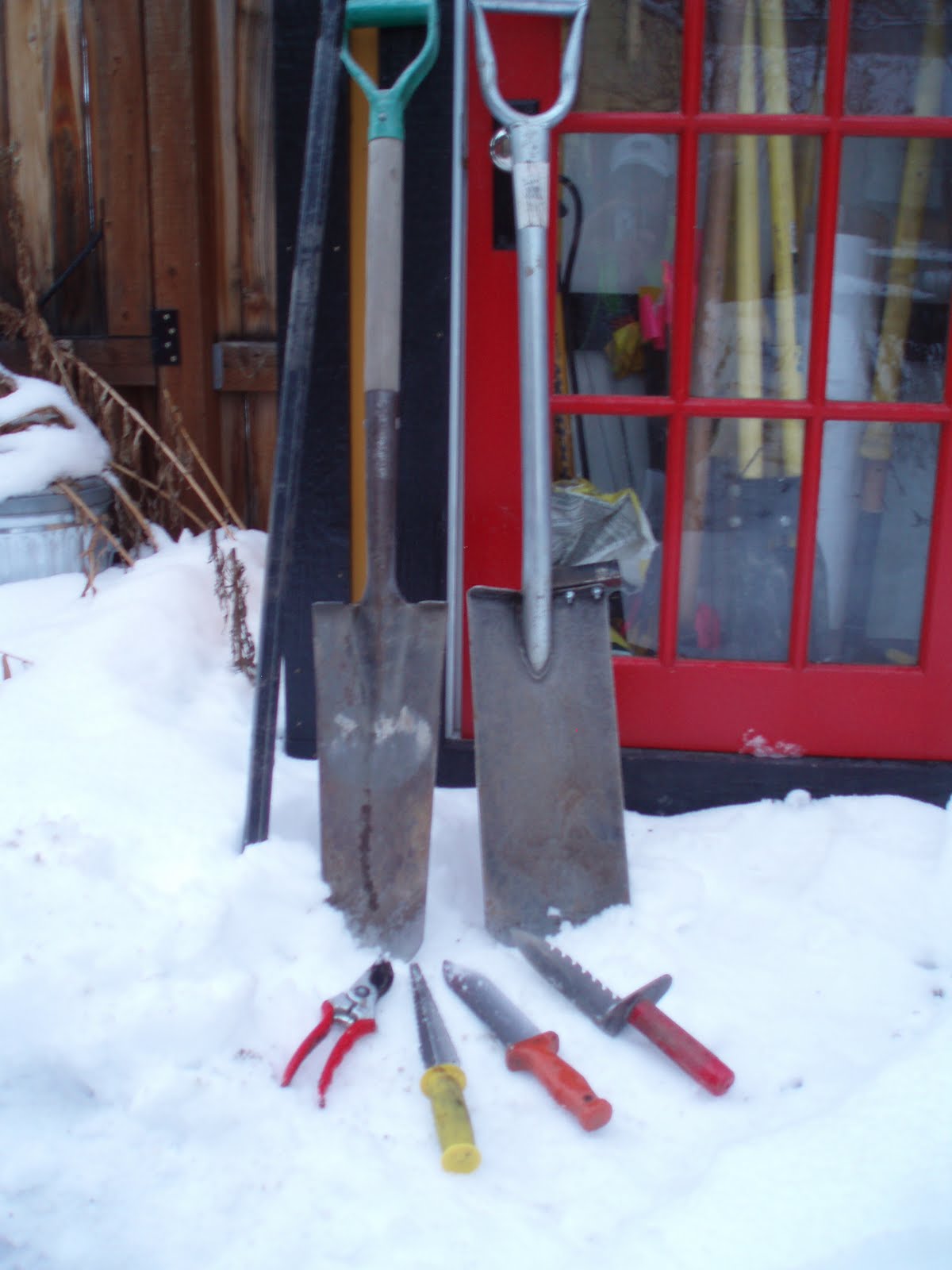
Here are some of my favorite garden tools:
AM Leonard soil knife, my favorite all around garden tool. This is the tool I reach for most often. I use it for transplanting, weeding, and any relatively small digging job. It is very well constructed and stout. You won’t bend or break this- it will last a lifetime. It is made with stainless steel and a orange poly something handle, easy to find, and will last forever, no splinters, and does not need any care. I have used a bunch of hori horis (Japanese soil knife) and other soil knives and this is my favorite. This knife has been redesigned and it is much better than the same model I currently have. The serrations are deeper and sharper, and it even has a twine cutting notch (pretty useful). Mine are several years old and probably have decades more use in them. A close runner up is the Lesche soil knife , it looks really cool and tough with the much more aggressive serrated edge and the hand guard. I have both and I like them. They are both made in the USA, which I also appreciate.
Diggit 2 weeding tool. This tool is nearly indestructible (and comes with a lifetime warranty) , with a bright yellow vinyl handle. It is really narrow to cut through compacted soil to get the deep roots of dandelions and other plants. It is so string and stout, that I use mine to pry up or reset concrete or urbanite pavers. For weeding in a small space it is my favorite, plus it is made in the USA.
Felco #2 pruning shears. I wrote a post about these a while back. A fantastic tool- there is a reason everyone likes these.
17# pencil point San Angelo bar (hard to take a picture of it, but it looks like a bar). Here is my shout out to Texas. The one I have been using for years was a wedding present (no lie, my wife and I registered for it). Around here digging holes does not require a shovel, but rather a digging bar and your hands. My favorite tool for the job is a 72”, hexagonal-shafted, chisel point on one end, pencil point on the other end, carbon steel digging bar. A friend of mine recently dug all the holes for a fence with a screw driver and a coffee can. The coffee can was for the soil. It can be really rocky here.
Drain spades- for general digging and transplanting I use one of these (the green handled one in the picture at the top of the post, and most of mine have been bent from using them as a pry bar or something), but they are light weight and good for general use. But when the digging gets tough, the one to use is this one: The King of Spades 16” rounded blade digging spade. This is a real piece of machinery. Heavy, sharp, unbend-able, with and removable and replaceable foot pad. Although not advertised as a pry bar, you can use it for one, and I have (made in the USA).