Saturday, July 9, 2011

The red breasted nuthatches are close to fledging: this is plain adorable

Make sure your volume is turned up when you watch the quick little video.

The red breasted nuthatches in the backyard nest box are growing quickly and they will soon fledge.  This was the nuthatches second attempt at a clutch. For whatever reason, the first clutch failed, but it looks like these little fellas are doing well.  A few years ago a pair of red breasted nuthatches had three failed attempts, but finally on the fourth try, all the nestlings fledged.  The adults were noticeably smaller and really haggard after building nests and finding food all spring and summer for four different clutches.  Watching that whole experience all spring and into late July gave rise to the expression my wife and I have- "we can all learn a lot from the nuthatches."

OK, I couldn't resist, here is another video.


Tuesday, July 5, 2011

2011 Garden Projects update

At the beginning of the year, I didn't think I had too many projects planned  for the garden, but I took a little time to write down a list of things to do, and I posted it here.  This is why I have a blog- it is my garden journal and it is a place to keep track of everything I'd otherwise scribble somewhere or forget to write down about the garden.


I planted some mountain ash (Sorbus scopulina), to replace the decadent aspen (Populus tremulodes)- and I even planted another one this weekend to replace an aspen that died suddenly last weekend in front of the hammock stand (below).  I have come to think of aspen as short-lived perennials, and that is fine.  Aspen bring so much wildlife- including wildlife that eat and kill them to the garden, that it is a fair trade (click here for more information).  Plus, we actually have more aspen in the garden now than when we started- they are just in different places, and they are always coming up in new areas.

I rearranged some plants in the front prairie, including getting rid of a green rabbit brush (Ericameria viscidiflora) and added a few Wood's rose (Rosa woodsii) close to the house.  In case you are wondering, the green rabbitbrush is now living at the Native Plant Garden at 8th and Grant.  Trust me.  It is fine.

I made a "cut-off" trail in front of the onion/ garlic bed (it is kind of obscured by the plants from this vew). The area near the grill shed is kind of a congested area in the garden and by adding this new trail/ path, people will be able to flow better. 
And along the way on the list, I added more things- a "green" or "living" roof for the grill shed, I started an insect collection to learn about and document all the insects in the garden (more on this soon), I removed the overhead garage door to the shop and replaced it with French doors (below), and I did some landscaping around the new space the French doors provide.

Adding the French doors to the shop was a fun little project and one I wished I had done a long time ago.  The doors add so much light and usable space in the shop.  Plus, they just look better.  I got all the materials for this at Home ReSource (a building materials re-use center, and my favorite place in the world to shop).
Green roof update
I didn't realize how much the green roof had grown, until I looked back on the post and slideshow from this spring. In general it is doing really well.  It is starting to fill in, and weeding has not been an issue.  I watered it for the first time yesterday (I planted it on April 24, but it was a very cool, wet spring).  Now that the weather has dried out and it has gotten hot (Sorry Susan, I know this mid-80's weather is not hot) or, perhaps, the weather has gotten more seasonal, I might water it once/ week through the summer. Here are some pictures showing the progress.
The picture below was taken right after planting, and as you can see, since then it has really filled in.
Below is a view looking down on the green roof.  It looks like a little prairie- just as planned.  All the plants are native to the Missoula area and include: Prairie June grass (Koeleria macrantha), Idaho fescue (Festuca idahoensis), Yarrow (Achillea millefolium), Rosy pussytoes (Anntenaria rosea), Cutleaf daisy (Erigeron compositus), Lanceleaf  stonecrop (Sedum lanceolatum), and  Elkhorn clarkia (Clarkia pulchella).  Click here for information about the green roof, including why I chose these plants.


To see the changes on the roof- here are a few pictures:  
Before- the old metal roof.
After I installed the green roof.
After some growing- it has really changed a lot.  A little tip- for garden projects, always take your "before" pictures in late winter, and your "after" pictures in the summer!
I made great progress on the list, but I still need to make that 3 bin composter for my wife, our compost management supervisor. But a new project has come up- another grape arbor.  There is always something to do, and a place to write it down.

Sunday, July 3, 2011

Garden Update for Independence Day Weekend

A guest post by David's Wife (David is pretty busy with his insect inventory of the garden, so I figured this is a good time for a guest post).

We stayed in town this weekend and I'm glad because the garden is extremely pleasant and interesting right now.  Here is a sampler of  some gorgeous pictures David took this morning .

It's hard to believe that we're already well past the "early" wildflowers, like sagebrush buttercups, biscuit roots, larkspur and even lupine and arrowleaf balsamroot.  The bunchgrasses are towering, the blue penstemons are fading, our chickadee family has left the nest box, and we are on to the true summer blooms, like Oregon sunshine (Eriophyllum lanatum, the bright orange) and clarkia (purple).
Clarkia are one of the only native annual wildflowers that put on a good show for the garden. They look beautiful scattered about singly, or when they pop up in huge clusters like the photo on the right.  Some people call these elk horns because of the shape of the petals. Here's a little Latin name geekery for those who might enjoy such things: clarkia's latin name is Clarkia pulchellum and was named after that one guy in the Lewis and Clark expedition.  Lewis, the other guy, had the Montana State Flower named after him, the bitterroot: Lewisia rediviva.  Of course it wasn't the state flower at the time, since Montana wasn't a state for a goodly time after the expedition, but my point is that they got some nice plants named after them.

Even though the early flowers have passed their flowering time, many of them have really stunning seeds or fruits. For example, look at this prairie smoke in the photo below. It's the pinkish one that looks like something out of a Dr. Suess book. Each flower of this plant makes dozens of seeds, and each seed has a feathery, wispy tail attached, which is how it got the common name prairie smoke. It looks like smoke.  The other common name for it it is old man's whiskers.  Check out the yarrow blooming in the background- they are starting to bloom like crazy.  By the way yarrow is a great perennial to include in your garden.  It has a bad reputation for spreading when it gets too much water, but it brings a lot to your wildlife garden (read more in this post "yarrow is not a four letter word"). 
Here's a close up of one of our serviceberry bushes- another early blooming species that is getting on with the seed formation. About a month ago serviceberry shrubs around Missoula were covered with white flowers the size of quarters.  This individual looks extra cool right now because it has some kind of rust disease growing on the leaves.  This is usually not a problem for the plants- lots of Montana shrubs have various rusts growing on them in the wild, and I've not heard of it becoming a problem (except for that situation with the blister rust and white bark pine, but that was an introduced disease). Notice the young berries hanging in the center of the photo. Don't they look like a combination of rose hips and baby apples? Serviceberries are related to both of those.  The berries are edible but usually pretty pithy, so leave them for the wax wings.


I mentioned yarrow above, and below are two more work horses of the Montana native plant and wildlife garden: showy fleabane (purple) and blanket flower (yellow and red, often with orange).  So simple and so beautiful, and so easy to grow.  They love sunny dry places, and although we never irrigate them, we always have plenty of flowers for bouquets.


A slightly more delicate plant (but not too much more delicate, it just likes a little bit of shade) is shown here growing near my backyard hammock. It's gorgeous. My hammock, that is. And the plant is nice, too. It is the mountain hollyhock, and the flowers look like they are made of porcelain or maybe the most terribly fine parchment paper you've ever seen. They hardly seem real. I like the non-native cottage garden species of hollyhock but this one is even better, almost too good to true. Fortunately for everyone it is not only true, but easy to grow and you can find starts at many of the local nurseries and Saturday markets in Missoula. Latin name is Iliamnus rivularis, just so you don't buy the wrong thing.


And another summer favorite is blooming its head off right now is mock orange (aka syringa). We have about fve of these, and the branches are bending down with the loads of flowers, which smell like citrus. This is the state flower of Idaho but that doesn't mean they are the only ones who get to enjoy it. It grows wild in Montana, too, you know. Today I snapped a picture with my cell phone of a swallowtail butterfly eating nectar from one of these. It was almost too much beauty all at once.


I've not even mentioned the scarlet gilia, golden aster, giant collomia or yellow evening primrose. Suffice it to say, the garden is off the hook. We're having an Open House Garden Party later this month, and if you are on our Butterfly Properties Constant Contact email list, you'll be getting an invitation soon. If you don't get an invitation, you are still invited. Let us know if you need the address and time.  


When you get here, you'll probably get to see the red breasted nuthatches feeding their nestlings.  However you won't be able to gain access to the nest because the parents have cleverly covered the opening in impenetrable sap.  So don't even think about it.  We, on the other hand, would welcome your visit!

Friday, June 17, 2011

Native Plant Gardening Events June 25 & 26


Next weekend my wife and I are organizing two native plant and wildlife gardening workshops/ events.  The first would help us complete a portion of the landscaping at Home ReSource (my favorite Missoula store), and the second is some maintenance work at the Native Plant Garden at 8th and Grant (pictured above).

My wife and I have a native plant, wildlife, and sustainable garden coaching and consultation business, Butterfly Properties, and each year we select a community project to work on as volunteers.  We enjoy spreading the beauty of native plants throughout town, and promoting an appreciation of Montana's flora.  The Native Plant Garden at 8th and Grant and Home ReSource's landscaping are two of our on-going projects.


We also support non-profits in other ways: offering discounted services to the Green Blocks participants, donating services to charity auctions, even giving actual money when we have it (we are even in the process of devleoping a grant program for community groups and non-profits).


We're planning some work at both these sites next weekend and we hope you will join us for a few hours and learn about landscaping installation, site preparation, design, and of course, weeding.

Saturday June 25, 10 am- 1 pm at Home ReSource, 1515 Wyoming Street

We are finishing the Home ReSource project by adding a "landscape pocket" on the Russell Street side. This new bed is an opportunity to learn about site preparation, native plant species, and garden maintenance. We love Home ReSource (their mission, their staff, and all the cool stuff they have for sale), and we have been donating our time and materials to this site since last year. (Here's a blog post from several months ago about spring maintenance in the HR gardens).

Topics/ activities:
Site preparation (when do you need to add topsoil? Why? Where do you get it?
Soil grading (What is it? How?)
How to plant plants
Mulch (Why? How? Where do you get it?)
Tour established native plant landscape at Home ReSource (completed in 2010).
Weed identification and removal (minimal)

Bring work gloves, sturdy shoes and questions!

Sunday June 26, 6:30 pm - 8:00 pm at the Native Plant Garden at 8th and Grant


Stop by and check out how beautiful this little park has become, and see what's flowering this week! Help clean up the park and learn about native plants and wildlife gardening. We will be weeding, pruning and maybe even planting a few plants. Bring gloves, and tools for weeding (if you have them). You can learn more about the park here.

Maybe we'll throw a few horseshoes in the horseshoe court, if there's time and energy. It's a wonderful community spot and we'd love to show it to you. Sunday June 26th, 6:30 pm- 8 pm.

You can view and even RSVP for both of these events on our Facebook site 

Wednesday, June 15, 2011

2011 will be remembered as the year of the aphid

WARNING!  This blog post contains explicit images of mucivory.


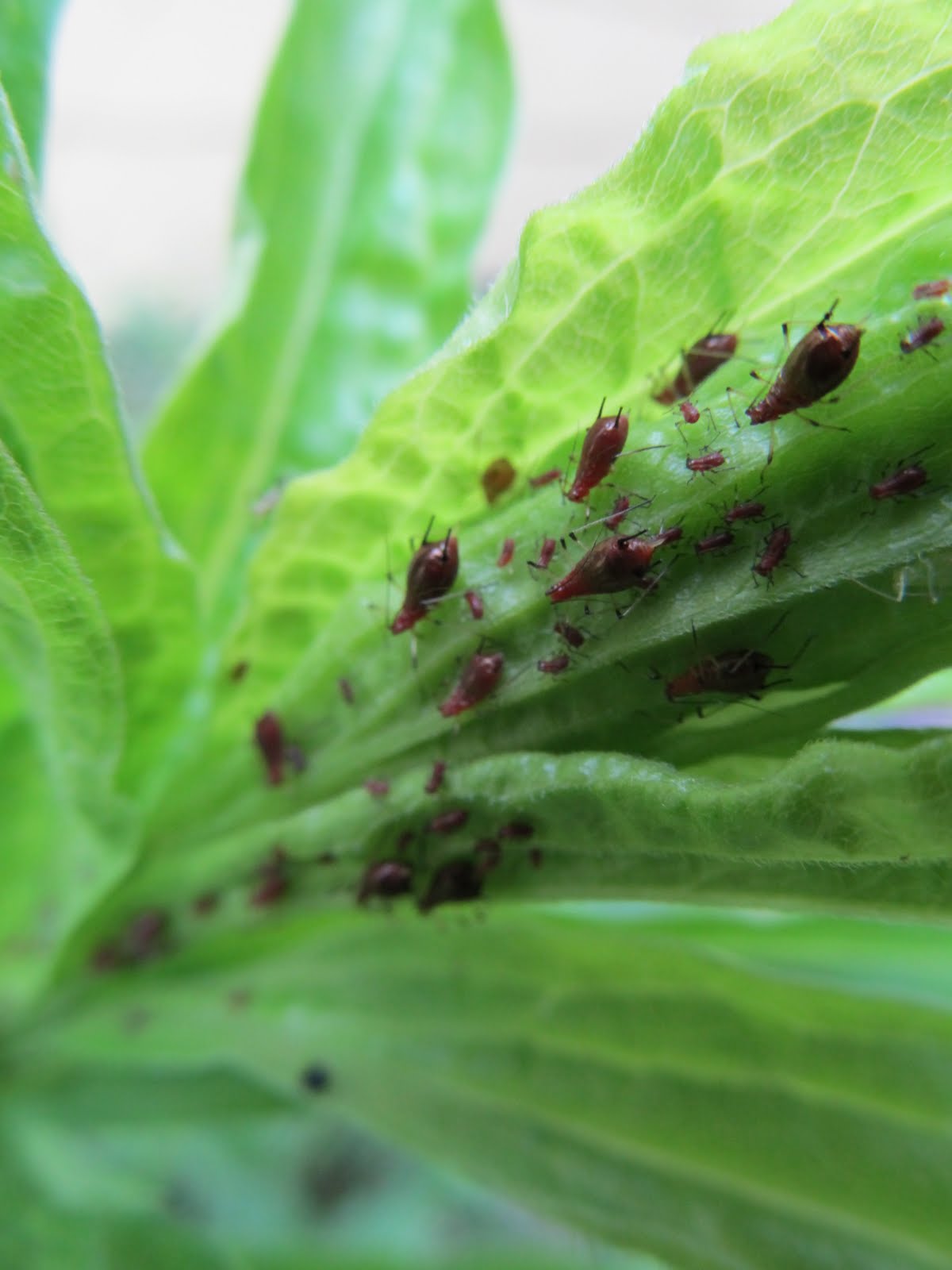
Every year, and every season, is different in the garden.  This year has been cool and wet, and some plants have really benefited like the arrow leaf balsamroot (Balsamorhiza sagittata), and some are having a tougher time like bitterroot (Lewisia rediviva).  That is why diversity in the garden is so important; and interesting.  The biggest benefactor, this year seems to be the aphids, though I am not sure why.  The abundance and diversity of aphids this year is incredible (on our native plants that is, not on our eggplants and peppers). 

A few years ago I was excited to find the red goldenrod aphids had finally colonized a little patch of goldenrod (Solidago missouriensis).  Last year though, none were in sight. 

This year it seems there are aphids on many species, different aphids on each of our goldenrod species (S. missouriensis, S. canadensis, and S. ridgida). 

Not just goldenrods, though.  There are aphids on our big basin sage (Artemisia tridentata - though they are there every year), red osier dogwood (Cornus sericea), 
chokecherry (Prunus virginiana), and 
Wilcox’s penstemon (Penstomon wilcoxii). 
This is even the first year I’ve seen aphids on our Ponderosa pines (Pinus ponderosa).  There are over 350 species of aphids, and most are host-plant specific.  That is, they only feed on a species of plant or plants that share a common genus. 
Compared to when our eggplants or peppers get aphids, when our native plants get colonized by a lot of aphids, it rarely results in damage to the plant.  Actually, our big basin sage seems to thrive in the presence of aphids. 

On our Ponderosa pines we have the giant conifer aphids (Cinara spp.).  These feed on the branches and stems, not on the leaves, and few arborists even consider these a threat.

All these aphids, though are really providing a lot of food for all the birds in the garden that glean insects from the leaves.  Also a benefactor is all the insects that feed on their soft bodies, which I am learning about thanks to my latest project- my insect collection. 

So far that has been a wonderful experience, and I am learning so much, even more than I expected (thanks again to Jen Marangelo from the Missoula Butterfly House and Insectarium ).  I am simply amazed by the diversity of bees, and flies that are wasp- and bee-mimics.  I am even really impressed by all the species of ladybird beetles in the garden- the sworn, mortal enemy of the aphid.

Monday, May 23, 2011

My new garden project- an insect collection


One new project I didn’t add to my list of garden projects for 2011 is documenting all the insects in our garden in the form on an insect collection.  I am really excited about this project. I haven’t made an insect collection since my college entomology class, so I am eager to relearn some identification and preservation skills.  One of my inspirations for this project came from Jen Marangelo (who was in that college entomology class with me) who is starting the Missoula Butterfly House and Insectarium. 

Jen, who has quickly emerged as the insect-human liaison in Missoula, was eager to help me get my little project underway and quickly gave me a list of tools, equipment and supplies I needed to get stared.  Today a box of everything I ordered arrived (I should note that it took over a month to get all these supplies from a company I won’t be promoting anytime soon.). Nevertheless, all my stuff is here, and I am excited to start searching for, documenting and "preserving the biodiversity" of our garden!

If you don't know about the Missoula Butterfly House, it is a great cause, and in a moment with Jen and seeing her enthusiasm for the project, you know it is going to succeed.  The mission of the Missoula Butterfly House is to promote an appreciation and understanding of insects and their relatives through public education and the development of an invertebrate education facility- a year round tropical butterfly house and an insect zoo with live insects, spiders, etc and hands-on exhibits.

The Missoula Butterfly House is a wonderful idea, and needs your help to become established, so consider becoming a member- membership is only $35 (and tax deductible).

I'm going to go outside and look for some more bugs. 

Wednesday, May 18, 2011

Backyard Birding, Bird Nesting and Garden Update

Do you ever take your laptop out to the back porch and use it to call in a ruby crowned kinglet, just to piss him off?  I do.

Anyway, I thought I’d take a moment to provide an update of what’s going on the in the garden.  It is a really busy time now- lots of stuff happening in the backyard (and elsewhere in life).  Spring is really here and birds are coming and going, plants are growing and flowering, and things are changing all around.


Garden update
Every year is different in the garden and that is what often makes it so much fun and interesting.  This year is shaping up to be another good year for arrowleaf balsamroot (Balsamorhiza sagittata)  in the garden (the last time I proclaimed this was in 2009, ironically on almost the same date – May 15).  By the way, 2010 sucked for balsamroot in our yard.  The exciting thing is so many of the volunteer balsamroots are still going strong, and in probably only 4 years our front yard will be awash in them (just as I predicted in 2009). 

2015, baby- lots of balsamroot.  Check back.

The other good news is that this year, volunteers from another one of our long-lived, slow to flower, plants, the silky lupine (Lupinus sericeus), is flowering!  This is the first time that has happened.  It takes about 5 years to flower and my wife started the originals from seeds in 2000.  So, a mere 11 years later we have flowers from the second generation.  This whole feat is probably worthy of a dedicated post (maybe I’ll try to convince her to write a guest spot).


Looking back on the pictures and the post about balsamroot in our garden from 2009, it shows how everything in the garden is on the same pace this year.  We had a slow spring, but now it seems like everything is suddenly caught up.

Speaking of getting caught up, I recently revisited my list of garden projects for 2011, and I am making some progress, and I’ve even added a few more projects.  The garden is never done, which is a good thing when you like to garden.
  • I planted some mountain ash (Sorbus scopulina) in the decadent quaking aspen (Populus tremuloides) stand.
  • I rearranged some plants in the front prairie, including getting rid of a green rabbit brush (Ericameria viscidiflora) and added some wood’s rose (Rosa woodsii), wax currant (Ribes cereum) and shrubby cinquefoil (Dasiphora fruticosa- by the way, when was the genus changed?) close to the house.
  • I made a "cut-off" trail in front of the onion bed. The area near the grill shed is kind of a congested area in the garden and by adding this new trail/ path, people will be able to flow better.
  • While I was at it making new trails and installing urbanite, I moved our concrete path 3’ to the north to make the bed larger and for traffic to flow better.  I am really happy how this turned out, and with all these projects, when things settle down, I’ll devote some time to individual posts.
Flax management

My motto with blue flax (Linum lewisii) is “a little goes a long way”.  Sure, it is aggressive, but it is beautiful, and the blooms last for 6 weeks or more.  It is a great accent plant in the garden to provide almost electric blue flashes of color.  But too much flax looks really weedy.  So, I actively manage it in the garden.  My plan usually involves removing older individuals- they get woody, too big, and they produce a lot of seeds.  In the wild, flax you see are typically about 3 stems or so, and, to me flax this size these look like they are appropriate in the garden.  I usually wait until after a rain, and pull them out by their taproot. Plants I get all the roots out of I save for friends (or enemies- a gardeners joke!), and the other ones I compost (though they are very slow to breakdown) or put on the brush pile.


This bucket of flax is heading to Kathy at Blackfoot Native Plants Nursery, who is a friend, I assure you.  She asked for them. I swear.

Bird Nesting Update
  • Nuthatches
    • They laid their eggs around May 4, so the eggs should hatch around… May 18th- today!  I need to spend sometime this evening loitering around the box.   
  • Chickadee
    • The chickadees have 8 eggs in their box, and hatching should be around May 24 (incubation is around 12 days).   You can always look into their box and see what’s happening on the nest box camera.
  • Flicker
    • The flickers have been around and have excavated the box.  They also excavated two holes in my neighbor’s silver maple.  They tried this last year, and I was so happy for them, but ultimately they got displaced by squirrels and nested in our backyard nest box.   I suspect they will nest here again.
Backyard Birding
The backyard birding has been really good this year. Species are coming and going on their way north, and to nest.  White crowned sparrows and Townsend’s solitaires in particular have spent a lot of time in the garden this year.  Also, Varied thrushes, Chipping sparrows, Bohemian waxwings, Song sparrows, Ruby crowned kinglets (including the angry little guy at the top of this post) and other species arrived at the same time as past years; hummingbirds seem a little farther behind.  There have been reports of hummingbirds from all over town over the last week or more, so they are here, and any day they’ll come to our garden.

Locally, the feeling is that things are behind schedule- owing to the cool spring, but the fact that species arrivals are in sync with past years speaks to the larger spatial scale at which they travel and interact with the landscape as a whole.  It is like the difference between weather and climate. Interestingly, yellow warblers arrived in our garden three weeks ahead of past years.

Looking back on the pictures and the blog post on balsamroot from 2009, I referenced earlier, it shows how everything in the garden is on the same pace as last year.  So the gist is, a lot is going on and it is just about the same as it always is.  Or something like that.

Wednesday, May 4, 2011

Nuthatch and chickadee nesting update

The red-breasted nuthatches completed their nest, and apparently have begun incubating eggs.  Today the female remained in the nest and the male visited regularly to feed her.  He also spent quite a bit of time smearing sap around the entrance to the nest (shown above). This behavior is characteristic of the red-breasted nuthatch, but several nuthatch species perform tasks that help keep their nest free of pests and parasites.  For example, white-breasted nuthatches with scrape the outside of their hole with bad smelling insects to dissuade intruders. 

The female will incubate the eggs for two weeks, so around May 18th the young should hatch.

This year we installed a camera on the outside of the nuthatch box, and we will stream it when things get interesting.  Next year, we'll probably move that camera inside their nest box.  

The chickadees are just about done with their nest construction and similar to the past, it is made mostly of squirrel fur, and some antelope hair.  The female has been roosting in the nest box for the last couple of nights, and I suspect she will begin laying eggs anytime now (if she has not already).  Unlike the nuthatches, we have a live streaming camera inside the nest box- click here to see what is going in inside 24/7.

Monday, May 2, 2011

Green Roof for the Grill Shed; phase 1

I posted a slideshow depicting my little green roof project last week (click here) and this is a follow up with some details about its construction and the plants I used.

Building this "green" or "living" roof was a really fun weekend project and one that I have been thinking about for a long time.  My initial thoughts about green roofs came about from discussions with Kevin DePuy of Adapt Design + Build.  He and I have talked about putting a green roof on the entrance to the Home ReSource building, and we each expressed our desire to try some new things; I wanted to try native plants, and Kevin was looking at it from a building perspective- about making some low-cost green roof solutions for a variety of roof pitches. 

So after some thinking and reading books about green roofs this winter, I figured the best way to learn is to try it, literally, in my own backyard.  What I learn here, I will hopefully incorporate into the green roof at Home ReSource, but really, I want to add a green roof to my garage (that will be Phase 2!).
Ironically, a few years ago, my friend Mike joked that my wife and I had already finished landscaping our yard, so what were we going to do next?  Then he quipped are you going to add another level?  Well, it turns out he was right!

Roof construction
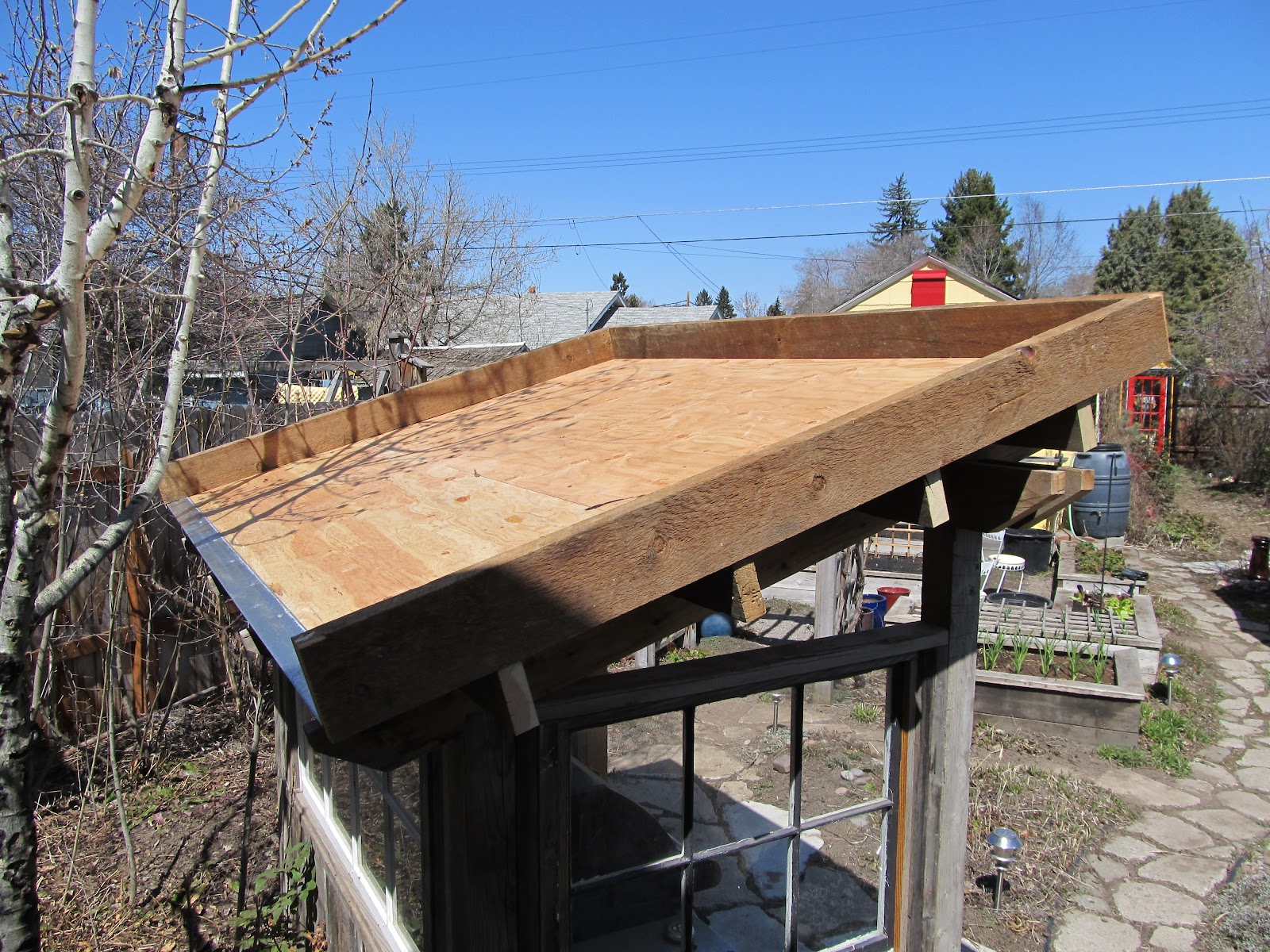
The first step in this project was removing the metal roof (it went back to Home ReSource, where I will probably end up buying it again!), and reinforcing the framing to bear the weight of the new roof.
I added reclaimed 2x5 purlins on top of the rafters, and sheathed the roof in exterior grade plywood.
Then I added a reclaimed metal drip edge,
and framed the rest of the roof with reclaimed, rough cut 2 x 6.

I then installed a self adhesive waterproof membrane- this is the most expensive part of the whole project, but luckily they have a bunch of this type of material at Home ReSource.  After some looking around, I found a lot of options there.  One was a rubber pond liner- this would work great, but I wanted to keep weight down, so I went with the membrane.
On top of the membrane, I laid down landscape fabric, and fully encased the gravel drainage layer. 
I added about 2” of gravel to the roof, and the reason I fully enclosed it was so the roots did not penetrate it, and so the gravel wouoldn’t shift or fall out of the drainage in the roof.
In retrospect, this is a lot of weight.  Although gravel is cheap, I’d look for another alternative for future green roofs.  I know many manufacturers sell plastic drainage layers and that might be the best alternative.  We’ll see.
Soil mix
On top of the landscape fabric I added a rooting media.   There are a lot of differing options and opinions on soil mixes for green roofs, and this is one area I wanted to experiment with. Over the course of mixing it and applying it, I changed the ratio a few times.  My initial plan was to use equal parts of compost, pumice, and perlite.  The whole idea is to have a light weight soil mixture, that has a fair amount of volume for roots, but drains well, and does not contain too many organics.  Although I considered using other materials like sphagnum peat, crushed Styrofoam and others, I eventually ruled them out.  As this progressed, I eventually stopped using compost- I was afraid of too much nutrients for the plants and the compost I also feared might hold too much water (for weight), and I switched to composted bark mulch (soil pep) and perlite.  
This is a really light and loose mix.  I went with 3”, and I think this will work out well.  In the end, it is probably ¼ perlite, 1/3 compost, ¼ composted mulch, and 1/6 pumice.
To hold everything in place while the plants got established, I covered the roof in burlap.  This will breakdown over time, and to plant it, I just cut holes in it.
Plant selection
I really wanted to use native plants for a green roof, and that is how this whole thing got started.  We’ll see how my selection goes, but my goal is to find a mixture that includes a diversity of plant species (read: not all sedum, like many green roofs), for human interest, wildlife (insects and the like) value and aesthesis, low rooting depth (that is, no taproots), fibrous roots that with help to bind the soil, plants that seed prolifically (to fill in the roof), a diversity of heights and textures, drought tolerant, plants that are easy to grow, species that are commercially available, and plants that are relatively low growing.  
Here is what I settled on: 
  • Prairie June grass (Koeleria macrantha), bunchgrass, prolific seeder, deepest root depth of the group
  • Idaho fescue (Festuca idahoensis), bunchgrass, prolific seeder, low rooting depth
  • Yarrow (Achillea millefolium), forms a mat and spreads with rhizomes, tallest plant (when in flower)
  • Rosy pussytoes (Anntenaria rosea) - forms a mat and spreads, their light foliage reflects sun
  • Cutleaf daisy (Erigeron compositus) - these form a low mat and flower for a long time (starting in April)
  • Lanceleaf  stonecrop (Sedum lanceolatum).  I used sedum because it is a requirement on any green roof.  It is mandatory. And they enforce this.  A nice succulent, though.
  •  Elkhorn clarkia (Clarkia pulchella) this is for color- they are annuals, with very shallow roots, but they readily reseed
Plants for this project I got from my own garden, from the UM Conservation Nursery at Fort Missoula and from Kathy at Blackfoot Native Plants Nursery, and the Elkhorn clarkia I grew from seeds from Native Ideals Seed Company.
I'll post updates about the successes (or failures) and we'll see how it goes.